Important AI Governance Standards Medium Businesses Need in 2026
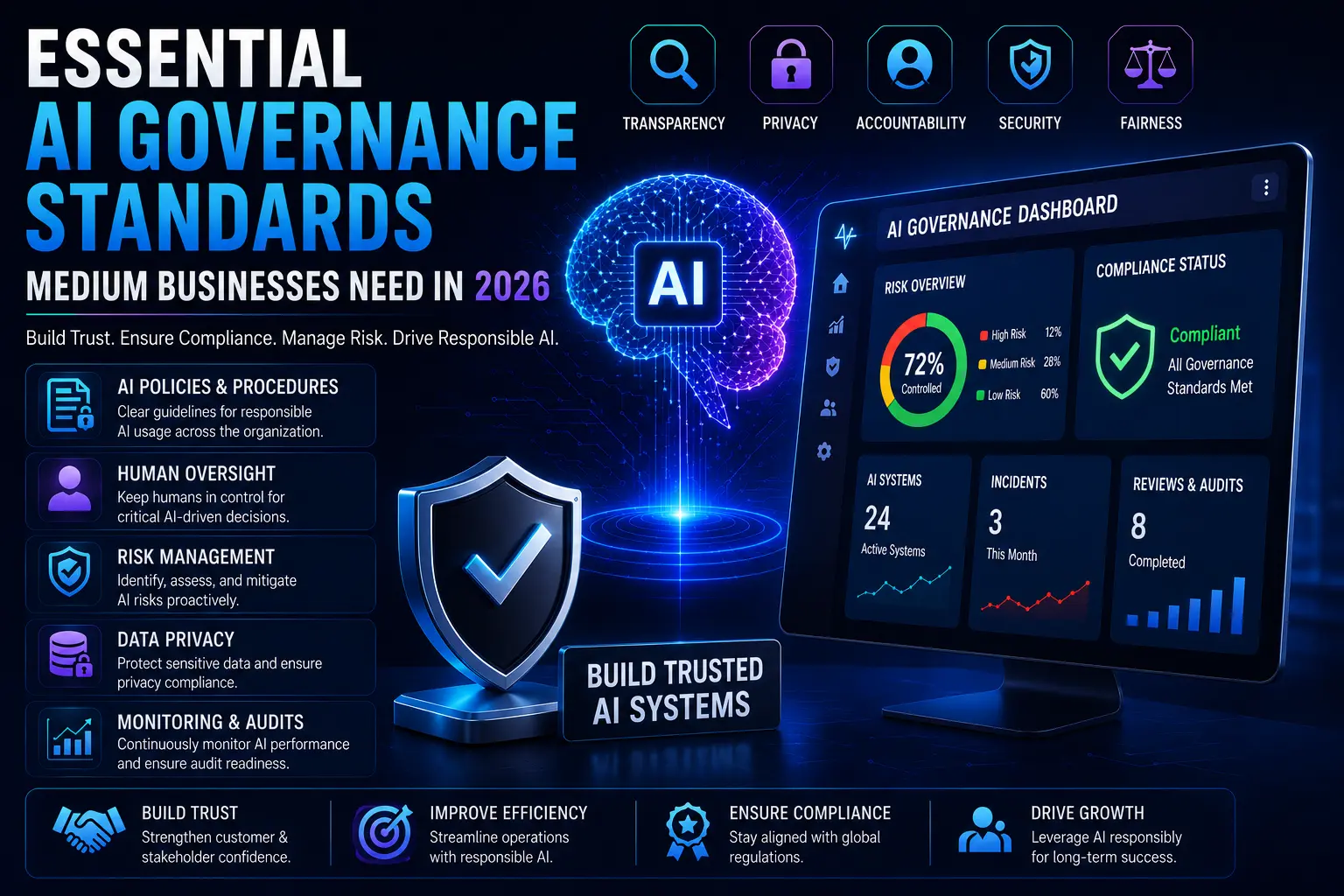
Essential AI Governance Standards Medium Businesses Need in 2026
Most medium-sized businesses did not expect AI to become operationally important this quickly. But somewhere between productivity gains, automation hype, and AI software subscriptions multiplying across departments, many companies quietly lost visibility into how artificial intelligence was actually influencing daily decisions. Honestly, that transition happened faster than most leadership teams were prepared for, highlighting why establishing clear ai governance standards medium companies can deploy has become a critical operational priority today.
One year businesses were casually testing AI writing assistants for internal tasks. The next year entire workflows suddenly depended on AI reporting systems, automated customer support, predictive analytics, workflow automation, internal AI copilots, and recruitment filtering tools. And now a growing number of managers are asking uncomfortable questions they barely considered two years ago: Who reviews these AI systems? What happens when automation generates inaccurate outputs? Which employees can use AI tools safely? How much internal data already entered external AI systems? That’s exactly why conversations around ai governance standards medium firms implement grew significantly more urgent.
Honestly, mid-sized companies face a particularly awkward challenge. Large enterprises usually have legal departments, compliance teams, governance officers, and cybersecurity specialists, while smaller startups often move fast with fewer processes. Medium businesses sit somewhere in the middle: too large for informal AI experimentation, but often too small for enterprise-level governance infrastructure. That awkward middle zone creates real operational risk surprisingly quickly, making practical ai governance standards medium frameworks essential for long-term stability.
Table of Contents
- What Are AI Governance Standards?
- Why Medium Businesses Suddenly Care About AI Governance
- Core AI Governance Standards Medium Companies Use
- AI Governance vs AI Compliance
- The Biggest AI Governance Risks
- How Medium Businesses Build AI Policies
- Practical AI Governance Workflow
- Best AI Governance Tools and Platforms
- Common AI Governance Mistakes
- Future Trends in AI Governance
- FAQ
- Final Thoughts
What Are AI Governance Standards?
AI governance standards are operational frameworks businesses use to manage artificial intelligence responsibly. In practice, they help organizations control AI risks, data protection, accountability, transparency, workflow reliability, compliance exposure, and cybersecurity concerns. That sounds technical initially, but honestly, most frameworks around ai governance standards medium enterprises use revolve around one simple goal: making sure AI behaves predictably inside real business operations.
One thing many businesses underestimate is that governance is not only about avoiding legal problems. It also deeply affects customer trust, operational stability, employee confidence, brand reputation, and workflow reliability. If you previously integrated tracking systems like the ziptie ai search performance tool or deployed specialized discovery options via the Ziptie AI tool, you already know that automated systems require constant baseline monitoring. Governance problems often appear quietly before businesses fully notice them.
Why Medium Businesses Suddenly Care About AI Governance
A few years ago, AI governance mostly sounded like a large enterprise discussion. Now, implementing structural ai governance standards medium parameters is a major boardroom topic. That shift happened faster than many executives expected due to three core drivers:
AI Adoption Accelerated Faster Than Internal Policies
Many businesses deployed AI tools long before creating governance structures around them. Honestly, this surprised a lot of leadership teams. Employees suddenly started using tools like ChatGPT, AI writing systems, and advanced workflow setups without clear operational guidelines. When internal reports or customer analytics enter cloud intelligence systems without oversight, organizing your ai governance standards medium rules becomes much more urgent.
AI Risks Became More Visible
Early AI adoption mostly focused on productivity gains. Now businesses increasingly worry about inaccurate outputs, hallucinations, data exposure, compliance issues, automation bias, and cybersecurity risks. One thing most online tutorials oversimplify is how messy AI operations become internally once multiple departments start using different tools simultaneously. Managing this chaos requires structured internal ai governance standards medium compliance strategies.
Customers and Partners Care More About AI Trust
Trust became surprisingly important, especially in sectors like healthcare, SaaS, HR, finance, and education. Customers increasingly ask how AI is being used, if data is protected, and whether humans review automated decisions. Ironically, some mid-market brands now govern AI more carefully than larger corporations because smaller teams can adapt their ai governance standards medium frameworks much faster.
Core AI Governance Standards Medium Companies Use
Most governance frameworks share similar operational foundations. The difference usually comes down to complexity, scale, and resource allocation.
- AI Transparency Standards: Businesses must understand how AI systems operate, what data enters workflows, and how outputs are generated. Avoiding “black box AI” protects your operational integrity.
- Data Privacy Controls: Implementing protective boundaries prevents employees from casually pasting confidential data, customer records, or financial analytics into external models.
AI Governance vs AI Compliance
A lot of people confuse governance and compliance. They overlap, but they are not identical. In practice, internal ai governance standards medium frameworks act as a broad strategy, while compliance serves as a specific execution layer within that system.
| AI Governance Focus | AI Compliance Focus |
|---|---|
| Internal operational strategy | External legal alignment |
| Workflow accountability and team safety | Regulatory requirements and official audits |
| AI risk management and model control | Audit readiness and official documentation |
| Ethical oversight and strategic balance | Compliance enforcement and legal safety |
The Biggest AI Governance Risks
Some governance risks appear immediately, while others develop slowly over time. Left unmanaged without ai governance standards medium protocols, these risks can severely damage organizational stability.
First, unapproved AI usage creates shadow AI systems and unmanaged automation across remote operations. This is particularly challenging for agencies leveraging the best AI tools for freelancers or pursuing the best AI side hustles without clear administrative oversight. Second, poor data protection leads to customer privacy exposure and accidental data leaks. Finally, blind trust in AI outputs can lead to hallucinations or flawed analytics that distort financial or HR choices.
How Medium Businesses Build AI Policies
Most medium businesses do not need enterprise-level governance bureaucracy immediately. Overengineering early on can slow down innovation. Instead, a streamlined approach to ai governance standards medium creation works best.
Step 1: Identify AI Usage
Audit your current AI tools, employee workflows, and automation systems. You cannot govern systems you don’t even track properly. For instance, catalog whether your content creators utilize the best AI tools for content creation or deploy external data processors.
Step 2: Define Risk Categories
Classify AI systems by operational risk to keep things practical. Low-risk applications include basic brainstorming tools, medium-risk involves marketing automation, and high-risk classifications cover core HR and financial engines.
Step 3: Create Practical Policies
Define approved tools, restricted workflows, data limitations, and security rules. Ensure these rules remain achievable; overly rigid systems usually frustrate employees quickly and lead to compliance evasion.
Step 4: Train Employees
This gets ignored constantly. Teams must understand AI limitations, privacy risks, verification practices, and escalation procedures. Otherwise, your ai governance standards medium manual remains a theoretical document nobody follows.
Practical AI Governance Workflow
Here’s a simplified workflow many medium businesses now use to enforce their corporate ai governance standards medium guidelines safely:
Input Layer: Employees submit proposed AI workflows or tool adoption requests for internal review.
↓
Risk Evaluation: Review teams assess data sensitivity, automation impact, and customer exposure risk.
↓
Approval Process: Assigned department managers approve, modify, or reject workflows based on established safety criteria.
↓
Monitoring Stage: The business tracks active AI outputs, unexpected anomalies, and security alerts.
↓
Ongoing Audits: Designated governance leads periodically review operational systems and update core policy parameters.
Best AI Governance Tools and Platforms
Businesses increasingly combine governance with automation, analytics, compliance, cybersecurity, and cross-departmental workflow management. According to enterprise technical insights by IBM watsonx Governance Systems, managing automated risk requires scalable tracking. Popular platforms include Microsoft Purview, IBM watsonx.governance, OpenAI enterprise controls, and Google Cloud governance tools.
Additionally, smaller operations configure manual tracking sheets or documentation blocks inside everyday tools like Zapier or Notion. While managing broader operational systems or checking the Drovenio AI tools 2025 workflow system, blending software logs with human checks keeps the framework affordable and agile.
Common AI Governance Mistakes
Avoiding frequent structural errors saves massive operational friction down the road. The most common mistake is creating overly complex policies that nobody actually uses. Simple, enforceable rules work significantly better. Another critical error is ignoring human oversight entirely; automation alone rarely solves complex organizational challenges without human judgment.
Furthermore, businesses often make the mistake of focusing only on legal compliance while failing to improve overall workflow quality. Finally, moving too slowly because AI technology evolves rapidly is a major misstep. Delaying your ai governance standards medium deployment because rules are changing actually increases your exposure over time.
Future Trends in AI Governance
AI governance will likely become much more standardized over the next few years. Several structural trends already stand out across the global marketplace:
- Industry-Specific Models: Sectors like healthcare, finance, HR, and SaaS are building specialized, pre-configured framework blueprints.
- Independent AI Audits: Third-party verification and formal AI compliance auditing are expanding significantly.
- Automated Governance Systems: Organizations are starting to use specialized AI algorithms to monitor internal AI usage and compliance metrics automatically.
- Stronger Global Regulations: International rules continue shifting rapidly. Staying updated via the latest AI compliance news and tracking compliance AI news updates is vital.
Furthermore, businesses must ensure their processes align with international benchmarks like the EU AI Act news feeds or broad AI regulation news today EU US trackers to preserve cross-border operations.
Smarter HR and Skills Integration
As organizations scale, human resources departments face intense pressure to manage automated tools safely. Reviewing resources like free AI tools for HR or the best free AI tools for human resources helps build strong data boundaries. Companies can also enroll management teams in the best AI human resources courses to unify data handling protocols.
For mid-sized firms looking to outsource technical components, hiring external experts who know how to start freelancing with no experience safely or understand the best freelancing skills to learn provides quick support. Enterprises find top talent on the best websites for freelancers, where specialized professionals utilize systems like AI tools for freelancers to optimize bids or an Upwork proposal automation tracker to support data-safe governance deployments.
Maximizing Safe AI Revenue Streams
Establishing proper ai governance standards medium guidelines also opens secure commercial avenues. If your business models touch on digital monetization, knowing how to make money online or exploring AI money making avenues requires deep architectural clarity. Governance keeps workflows reliable as you learn how to make passive income with AI or build an AI passive income generator asset.
By protecting internal assets and aligning with the long-term future of AI systems, organizations can explore our collection of 100 ways to make money with AI 2026 safely. This structured path ensures that your operational growth remains entirely profitable, compliant, and free from unexpected liabilities.
FAQ
What are ai governance standards medium businesses follow?
They are customized operational frameworks that mid-sized organizations use to manage AI risk, protect sensitive data, and enforce accountability without enterprise bureaucracy.
Why do mid-market companies need specialized AI governance?
As adoption scales, medium businesses quickly outgrow informal monitoring but lack massive legal teams. Structured governance helps maintain data security and partner trust.
Is AI governance identical to regulatory compliance?
No. Governance focuses on overall internal operational control and workflow quality, while compliance ensures alignment with specific external laws and legal rules.
Which sectors face the highest AI governance demands?
Healthcare, finance, human resources, SaaS, and cybersecurity experience the highest scrutiny regarding automated decisions and data processing.
Final Thoughts
The conversation around ai governance standards medium businesses follow is evolving quickly. Some organizations probably overcomplicate governance, while others ignore it completely. The smartest approach sits somewhere in the middle. You don’t necessarily need massive enterprise-level bureaucracy immediately, but once AI starts influencing daily operational choices, some structure becomes essential surprisingly fast. Ultimately, governance is not only about avoiding legal trouble; it’s about protecting your operational trust, workflow reliability, customer confidence, and long-term stability.
Build Secure and Scalable AI Systems
Ready to protect your enterprise workflows and implement data-safe automation strategies? Explore our comprehensive directory of verified tools to guide your scaling journey.
Explore Top AI Tools