
AI Regulation Europe News Today: Latest EU AI Act Updates Explained for Businesses in 2026
Introduction
Artificial intelligence is evolving faster than almost any other technology, but innovation is no longer the only story. Regulation has become just as important. If you’ve searched for AI regulation Europe news today, you’re probably trying to understand what has changed, who is affected, and whether these new rules will influence the AI tools you use or the business you run.
Here’s the thing—Europe is setting the pace for AI regulation around the world. While companies like OpenAI, Google, Microsoft, Anthropic, and countless startups continue releasing new models, European lawmakers are focused on ensuring that AI systems remain transparent, safe, and accountable. The result is the EU AI Act, the world’s first comprehensive legal framework specifically designed for artificial intelligence.
For businesses, freelancers, software developers, marketers, and even content creators, these regulations are no longer optional knowledge. Whether you’re building AI-powered applications, using ChatGPT to streamline your workflow, automating business processes with tools like Zapier or Notion, exploring practical AI tools for freelancers to optimize bids, or simply following the future of AI, understanding the latest AI regulation Europe news today can help you avoid costly mistakes and prepare for future compliance.
One thing most beginners overlook is that AI regulation isn’t meant to stop innovation. In practice, it’s designed to build trust. Companies that understand compliance early often gain a competitive advantage because customers increasingly care about privacy, transparency, and responsible AI usage.
In this guide, you’ll learn what the latest European AI regulations actually mean, how the EU AI Act works, who needs to comply, and why these developments matter even if your business is based outside Europe.
Table of Contents
- What Is AI Regulation Europe News Today?
- Why the EU AI Act Matters in 2026
- Latest AI Regulation Europe News Today Updates
- Understanding the EU AI Risk Categories
- How Businesses Should Prepare
- Best Tools for AI Compliance
- Step-by-Step Compliance Workflow
- 30-Day Practical Example
- Comparison Table
- Pros and Cons
- Expert Tips
- Future Trends
- FAQ
- Final Verdict
What Is AI Regulation Europe News Today?
Artificial intelligence has moved far beyond simple chatbots. Today, AI helps companies recruit employees, approve loans, diagnose diseases, write software, generate marketing content, detect fraud, and automate business operations. As AI becomes more powerful, regulators face an increasingly difficult question:
How can innovation continue while protecting people from harmful AI systems?
Europe’s answer is the EU AI Act.
Unlike many existing technology laws that focus only on data privacy, the AI Act specifically regulates how AI systems are developed, deployed, and monitored throughout their lifecycle.
Rather than treating every AI application the same, the legislation uses a risk-based approach. That means the stricter the potential impact on people’s rights or safety, the stricter the legal requirements become.
For example:
- AI systems used for entertainment generally face fewer restrictions.
- AI used in healthcare requires far greater oversight.
- AI that evaluates job applicants or credit applications must satisfy extensive transparency and fairness requirements.
- Certain uses of AI are prohibited altogether.
From a practical standpoint, this flexible model allows businesses to continue innovating while placing additional safeguards around high-risk applications.
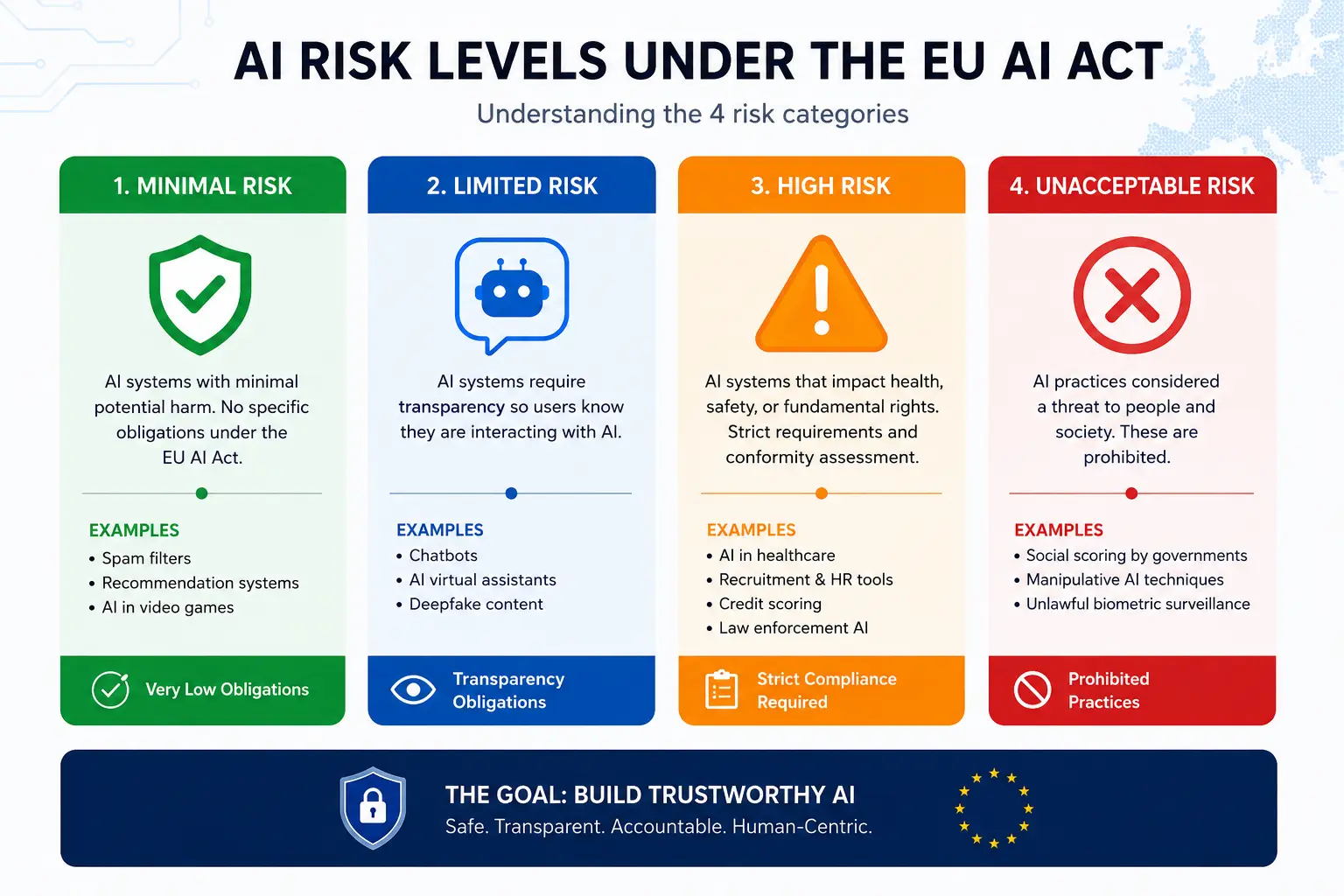
The Four AI Risk Levels
One of the biggest reasons the EU AI Act receives so much attention in AI regulation Europe news today is its straightforward classification system.
| Risk Level | Description | Example |
|---|---|---|
| Minimal Risk | Very limited obligations | Spam filters |
| Limited Risk | Transparency required | AI chatbots |
| High Risk | Strict compliance rules | Hiring software |
| Unacceptable Risk | Completely prohibited | Social scoring systems |
This framework helps organizations quickly determine which compliance obligations apply to their AI systems.
Why the EU AI Act Is Different
Previous regulations such as the GDPR primarily focused on personal data. The AI Act expands that responsibility by evaluating the behavior of AI systems themselves.
Companies must increasingly demonstrate:
- transparency
- accountability
- human oversight
- cybersecurity
- documentation
- risk management
- ongoing monitoring
That sounds simple in theory. The reality is slightly different. Many businesses currently use dozens of AI-powered applications across marketing, HR, customer service, software development, and analytics without maintaining any centralized inventory of these tools.
One of the first compliance steps recommended by AI governance experts is simply identifying every AI system already operating inside your organization.
Why the EU AI Act Matters in 2026
Surprisingly, these rules affect far more than European technology companies. If your organization develops, sells, distributes, or even uses AI services available within the European market, parts of the regulation may still apply.
That includes:
- SaaS companies
- AI startups
- Software developers
- Enterprise organizations
- Digital agencies
- Marketing teams
- Freelancers building AI automations
- AI consultants
- Online educators
- AI product creators
Even businesses headquartered in the United States often serve European customers. That means compliance increasingly becomes part of global business strategy rather than a regional legal issue.
Another reason this topic continues dominating AI regulation Europe news today is the growing relationship between regulation and customer trust. Businesses are beginning to ask vendors questions like:
- Is your AI system compliant?
- How is customer data processed?
- Is human oversight included?
- Can outputs be audited?
- Is the model transparent?
Organizations that can confidently answer these questions may gain a meaningful competitive advantage over companies that ignore AI governance. The reality is usually less glamorous than many YouTube videos suggest. Compliance isn’t just about filling out paperwork. It often requires changes to documentation, internal workflows, employee training, vendor selection, and ongoing monitoring.
Still, companies that prepare early typically find the transition far easier than those waiting until enforcement deadlines arrive.
Latest AI Regulation Europe News Today Updates
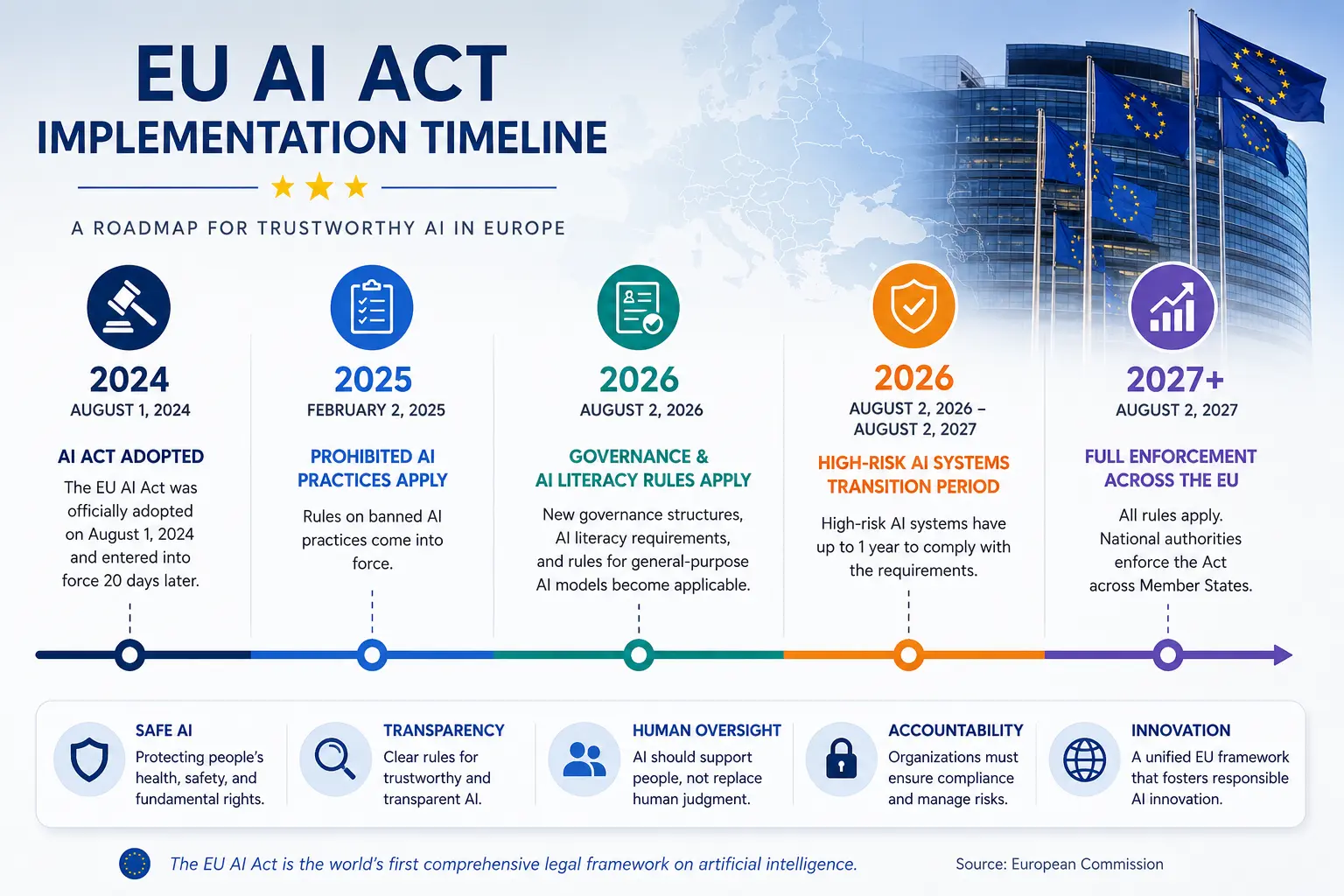
Here’s the thing—many people think the AI Act suddenly became one massive law overnight. In practice, implementation happens gradually. Different parts of the regulation become enforceable over time, giving organizations an opportunity to adapt their internal processes before the strictest compliance obligations take full effect.
For businesses, this means preparation is no longer optional. The companies that wait until the last minute will almost certainly spend more time and money than organizations that begin preparing today.
For official implementation dates, businesses should also review the European Commission AI Act implementation timeline, because the law applies progressively rather than all at once.
The Biggest Topics Dominating AI Regulation Europe News Today
1. AI Literacy Requirements
One of the most discussed updates is the growing emphasis on AI literacy. Organizations are expected to ensure employees understand how AI systems work, where AI can fail, bias risks, hallucinations, privacy considerations, cybersecurity risks, and human oversight. Training employees may become just as important as purchasing AI software.
2. High-Risk AI Systems
The EU continues focusing heavily on high-risk AI. These include AI used for hiring employees, education, law enforcement, healthcare, banking, insurance, border control, and critical infrastructure. These systems require significantly more documentation than ordinary AI chatbots. Companies must demonstrate that their AI systems are monitored, documented, secure, explainable, and continuously evaluated.
3. Transparency Rules
Transparency remains one of the biggest themes in AI regulation Europe news today. Users should understand when they are interacting with AI.
AI-generated content may require disclosure.
AI chatbots should identify themselves.
Deepfakes may require clear labeling.
Transparency builds trust while reducing misinformation.
4. General-Purpose AI Models
Large foundation models such as ChatGPT, Claude, Gemini, and similar systems receive increasing regulatory attention. Rather than regulating only individual applications, Europe is also introducing obligations for providers of powerful general-purpose AI models. These discussions continue evolving as AI capabilities improve rapidly.
Understanding the EU AI Risk Categories
Risk Level Comparison
| Risk Category | Examples | Compliance Level |
|---|---|---|
| Minimal Risk | Spam filters, recommendation engines | Very Low |
| Limited Risk | Chatbots, AI assistants | Transparency Requirements |
| High Risk | Hiring, healthcare, education | Extensive Documentation |
| Unacceptable Risk | Social scoring, manipulative AI | Prohibited |
Minimal Risk
These applications generally require very little additional compliance. Examples include spam detection, recommendation systems, AI-powered games, and simple automation. Most businesses using these systems experience minimal regulatory burden.
Limited Risk
Limited-risk systems primarily require transparency. If users communicate with AI, they should know they’re interacting with artificial intelligence rather than a human. Examples include ChatGPT-style assistants, customer support bots, AI writing assistants, and virtual shopping assistants.
High Risk
This is where compliance becomes much more demanding. Organizations may need risk assessments, quality management systems, documentation, human oversight, cybersecurity controls, and post-market monitoring. Examples include medical diagnosis AI, recruitment software, university admissions, credit scoring, and biometric identification.
Unacceptable Risk
Certain AI practices are prohibited because they pose unacceptable risks to fundamental rights. Examples include government-style social scoring, manipulative behavioral AI, certain forms of biometric surveillance, and AI exploiting vulnerable populations. These prohibitions represent one of the defining characteristics of the EU AI Act.
How Businesses Should Prepare
Preparing for the evolving landscape of European AI laws requires a structured approach. Organizations should take look into their active software architecture and determine the scope of automated decision-making systems. This shift isn’t just about following the law; it’s also about staying in line with global data protection developments, such as those monitored via compliance AI news networks.
A key element of readiness involves tracking cross-border policies. For companies serving both Western and European markets, staying informed through broader perspectives like AI regulation news today EU & US helps maintain a unified framework for standard operations without duplicating structural paperwork.
Best Tools and Resources for AI Compliance
Recommended Tools
| Tool | Best For | Beginner Friendly | Notes |
|---|---|---|---|
| Microsoft Purview | Data governance | ⭐⭐⭐⭐☆ | Excellent for Microsoft environments |
| Notion | AI policy documentation | ⭐⭐⭐⭐⭐ | Flexible and affordable |
| Zapier | Workflow automation | ⭐⭐⭐⭐⭐ | Helps automate compliance workflows |
| Microsoft Copilot | Internal productivity | ⭐⭐⭐⭐☆ | Enterprise integration |
| Semrush | AI content monitoring | ⭐⭐⭐⭐⭐ | Helpful for marketing teams |
If you’re comparing AI tools before building a workflow, you can also review our guides on best AI tools for freelancers, top AI tools, and best AI tools for content creation.
Which Businesses Should Prioritize Compliance?
- SaaS Companies: High priority. Their software often reaches multiple countries, including Europe.
- AI Startups: Very high priority. Investors increasingly evaluate governance alongside innovation.
- Marketing Agencies: Moderate priority. Agencies frequently use AI-generated content, automation, and analytics. Transparent AI usage strengthens client trust.
- Freelancers: Lower—but growing—priority. Freelancers using AI for writing, design, or automation should understand disclosure requirements and client expectations. For those just getting started, looking into the best AI tools for freelancers can assist in tracking basic operational parameters safely.
Step-by-Step Implementation
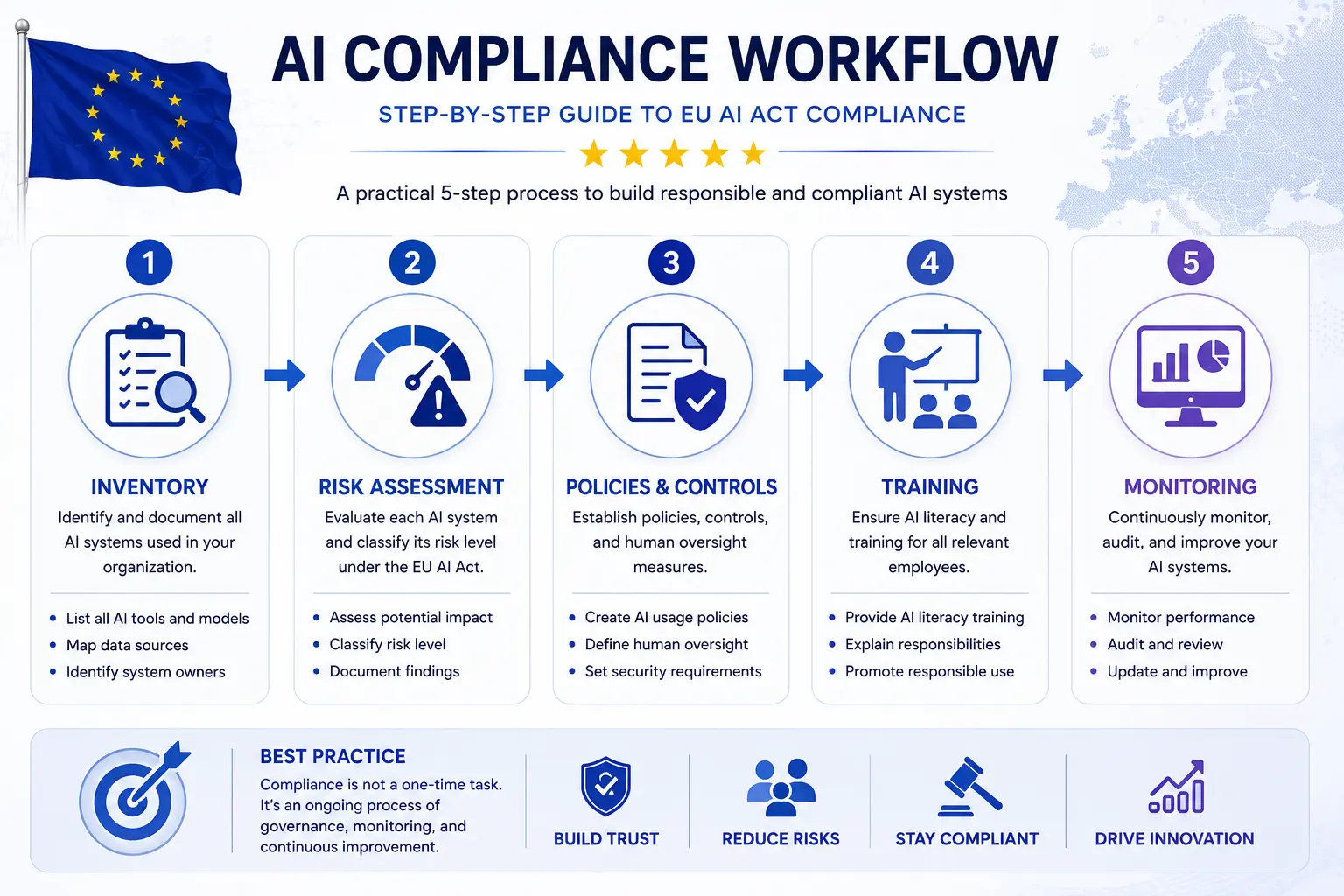
Step 1 — Inventory Every AI Tool
Begin by listing every AI solution your organization uses. Include ChatGPT, Claude, Google Gemini, Microsoft Copilot, Canva AI, Notion AI, CRM automation, and internal AI assistants. Most companies discover far more AI usage than expected. To review potential variations across corporate departments, check out lists of the top AI tools to help categorise legacy components.
Step 2 — Classify Risk
Determine whether each AI application falls into Minimal Risk, Limited Risk, or High Risk. This classification drives future compliance efforts.
For a broader risk-management perspective, businesses can also review the NIST AI Risk Management Framework, especially when building governance practices for AI systems used across multiple teams.
Step 3 — Create Internal Policies
Document acceptable AI usage, employee responsibilities, human review requirements, security procedures, and the vendor approval process. Policies reduce confusion across teams.
Step 4 — Train Employees
Employees should understand hallucinations, privacy risks, prompt security, confidential information, copyright issues, and responsible AI usage. Training is one of the most overlooked compliance investments.
Step 5 — Monitor Continuously
AI changes quickly. Compliance isn’t a one-time project. Organizations should regularly review vendors, model updates, new regulations, internal usage, and security incidents. Continuous improvement becomes part of responsible AI governance. You can follow active updates via AI compliance news indices to maintain structural relevance.
Realistic 30-Day Example
This is an illustrative example and not a guarantee of results.
Imagine a mid-sized marketing agency preparing for AI compliance.
- Week 1: Inventory every AI tool, identify vendors, and review current workflows.
- Week 2: Classify AI systems by risk, create documentation, and draft an AI usage policy.
- Week 3: Train employees, update contracts, and review cybersecurity practices.
- Week 4: Conduct an internal audit, improve documentation, and schedule quarterly compliance reviews.
30-Day Workflow Table
| Week | Action | Expected Outcome |
|---|---|---|
| Week 1 | AI inventory | Complete visibility |
| Week 2 | Risk assessment | Compliance roadmap |
| Week 3 | Team training | Better AI awareness |
| Week 4 | Internal audit | Continuous governance |
Practical Observation: From a practical standpoint, the biggest challenge isn’t understanding the regulation—it’s keeping track of every AI system employees start using on their own. Many organizations discover unofficial AI tools long before they complete their first compliance review.
Comparison Table: Enterprise vs Small Business Approaches
| Feature | Enterprise Strategy | Small Business Strategy |
|---|---|---|
| Resource Allocation | Dedicated legal and compliance teams | Shared admin or outsourced consultants |
| Tool Tracking | Automated enterprise monitoring networks | Manual asset spreadsheets and team inventories |
| Update Frequency | Real-time policy modifications | Quarterly review cycles |
Pros and Cons of the EU AI Act
Here’s the reality: whether you see the regulation as an opportunity or a burden often depends on your business model. Large enterprises usually have dedicated compliance teams, while startups and freelancers may need to balance innovation with limited resources.
Advantages
- Increased Trust: Customers are more likely to adopt AI systems that demonstrate transparency and accountability.
- Global Influence: Many companies outside Europe are adopting EU standards because they operate internationally.
- Better Risk Management: Documenting AI systems helps reduce legal, ethical, and operational risks.
- Competitive Advantage: Early adopters of AI governance can stand out when selling to enterprise clients.
- Higher AI Quality: Continuous monitoring often leads to more reliable and secure AI systems.
Disadvantages
- Compliance Costs: Documentation, legal reviews, and governance programs require time and investment.
- More Administrative Work: Businesses must maintain policies, records, and monitoring procedures.
- Learning Curve: Many organizations are still trying to understand the regulation.
- Startup Pressure: Smaller AI startups may struggle with limited compliance resources.
- Rapid Evolution: AI technology changes faster than regulation, making continuous adaptation necessary.
Best Use Cases
Not every organization will be affected in the same way. The impact depends on how AI is used within your business.
- Large Enterprises: Best suited for organizations that deploy AI across multiple departments, operate internationally, manage sensitive customer information, and sell AI-powered software. Expected outcome: A structured governance program that supports long-term growth and customer trust. For human resource groups evaluating automated hiring tools, platforms like the best free AI tools for human resources or taking best AI human resources courses can provide specialized integration steps.
- SaaS Companies: Excellent candidate for early compliance. Many SaaS providers serve customers throughout Europe, making proactive preparation worthwhile.
- AI Startups: Although compliance may initially feel overwhelming, building governance into products from day one often saves significant effort later.
- Marketing Agencies: Agencies increasingly rely on AI copywriting, image generation, analytics, and automation. Clear internal policies reduce client concerns and improve professionalism. Incorporating safe frameworks is highly recommended for agencies exploring best AI tools for content creation.
- Freelancers: Freelancers using ChatGPT, Claude, Google Gemini, Canva AI, or Microsoft Copilot should understand responsible AI practices, especially when handling confidential client information. Those exploring modern pathways can balance safety and earnings by examining best AI side hustles or the 100 ways to make money with AI in 2026.
Common Mistakes to Avoid
- Assuming AI Regulation Only Affects Europe: One of the biggest misconceptions. If your customers are located in Europe, certain obligations may still apply even if your company operates elsewhere.
- Not Knowing Which AI Tools Employees Use: Shadow AI is becoming increasingly common. Employees often adopt new AI tools without informing IT or management. Creating an AI inventory should be one of your first governance tasks.
- Ignoring Documentation: Documentation isn’t just paperwork. It demonstrates accountability if regulators or customers ask how AI systems are used.
- Treating Compliance as a One-Time Project: AI models evolve constantly. Policies should evolve alongside them. Annual reviews are helpful, but quarterly assessments are often more practical for organizations using AI extensively.
- Forgetting Human Oversight: Automation is valuable. Complete automation without human review can create unnecessary risk, especially for high-impact decisions.
Expert Tips
After following AI governance developments for several years, a few practical patterns continue appearing across successful organizations.
Start Small
You don’t need a complex governance framework on day one. Begin with an AI inventory, basic policies, employee training, and an approved tools list. Then improve gradually.
Focus on Transparency
Customers rarely expect perfection. They appreciate honesty. Explain where AI is used, how outputs are reviewed, and what safeguards exist. Transparency often increases customer confidence.
Review Vendors Carefully
Before purchasing AI software, ask: Where is data stored? Is customer data used for model training? What certifications are available? How is security managed? Is human oversight supported?
Build Governance Into Existing Workflows
Rather than creating separate compliance processes, integrate AI governance into onboarding, cybersecurity, procurement, risk management, and software approvals. This reduces administrative overhead. For enterprise operations processing human capital metrics, checking specialized systems like free AI tools for HR assists in mapping specific touchpoints seamlessly.
Future Trends
- Greater Focus on Foundation Models: Large AI models such as ChatGPT, Claude, Gemini, and future systems will continue receiving regulatory attention.
- International Alignment: Countries outside Europe are already studying the EU AI Act. Future regulations may become increasingly compatible across multiple jurisdictions.
- AI Auditing: Independent AI audits are expected to become more common, particularly for enterprise software.
- Governance Platforms: Demand for AI governance software will likely increase as organizations seek easier ways to manage compliance.
- Responsible AI as a Competitive Advantage: Responsible AI is gradually shifting from a legal obligation to a business differentiator. Organizations that can demonstrate transparency may gain stronger customer relationships.
Future AI governance will also connect with search visibility, content transparency, and AI-generated information tracking. For SEO-focused teams, tools like Ziptie AI tool, Ziptie AI search performance tool, and Ziptie SEO can support visibility monitoring as AI search continues to evolve.
Frequently Asked Questions
1. What is AI regulation Europe news today?
It refers to the latest updates, enforcement actions, and policy developments related to artificial intelligence regulation across the European Union, particularly the EU AI Act.
2. Does the EU AI Act affect companies outside Europe?
Yes. Organizations offering AI products or services within the EU may have obligations even if they are headquartered elsewhere.
3. What is considered a high-risk AI system?
Examples include AI used in healthcare, hiring, education, law enforcement, financial services, and critical infrastructure.
4. Are ChatGPT and other AI assistants banned?
No. General-purpose AI systems are not banned, but providers and deployers may have transparency and compliance responsibilities depending on how the technology is used.
5. When does the EU AI Act apply?
The Act is being introduced in phases, with different obligations becoming applicable over time.
6. Do freelancers need to worry about AI regulation?
Freelancers should understand responsible AI practices, especially when working with European clients or processing sensitive information. Developing foundational digital qualifications can help freelancers navigate these rules smoothly; consider reviewing best freelancing skills to learn or finding assignments on the best websites for freelancers to build an on-brand, legally sound consulting business.
7. What is AI governance?
AI governance refers to the policies, processes, controls, and oversight used to ensure AI systems operate responsibly, securely, and transparently.
8. How can businesses prepare today?
Start by identifying AI tools, assessing risk levels, documenting usage, training employees, and reviewing AI vendors regularly.
9. Will AI regulation slow innovation?
While compliance introduces additional responsibilities, it can also increase trust, reduce risk, and encourage sustainable AI adoption.
10. Where can I follow AI regulation Europe news today?
Follow updates from the European Union, trusted legal resources, and reputable AI industry publications to stay informed about new requirements.
Final Verdict
Artificial intelligence is moving at an extraordinary pace, and regulation is evolving alongside it. Understanding AI regulation Europe news today is no longer just a legal concern—it has become an essential part of responsible AI adoption for businesses, developers, marketers, freelancers, and enterprise teams.
The EU AI Act introduces a practical, risk-based framework that encourages innovation while protecting users and fundamental rights. Although compliance may require additional effort, organizations that prepare early are likely to build stronger customer trust, reduce operational risks, and adapt more easily as AI regulations continue to mature.
Whether you’re developing AI applications, integrating tools like ChatGPT or Microsoft Copilot into your workflow, or simply following the future of artificial intelligence, staying informed about AI regulation Europe news today will help you make smarter long-term decisions.
The best time to begin preparing isn’t when enforcement arrives—it’s while you still have time to build responsible AI practices into your everyday operations.
Ready to Build AI Responsibly?
As AI regulations continue to evolve, combining strong governance with the right AI tools can help your business remain competitive, productive, and trusted.
Explore more expert guides on AI tools, AI compliance news, compliance AI news, AI regulation news today EU & US, and EU AI Act news to stay ahead of the next wave of responsible AI innovation.