How Effective Is Ziptie AI Search Optimization? An Honest Review for 2026
Introduction
Artificial intelligence is changing how people discover information online. Instead of relying only on traditional Google searches, millions of users now ask questions directly to AI assistants like ChatGPT, Claude, Perplexity, and Google Gemini. That shift has created a completely new challenge for website owners and marketers: how do you optimize content for AI search?
If you’ve been researching how effective is Ziptie AI search optimization, you’re probably wondering whether the platform actually helps improve visibility inside AI-powered search experiences or if it’s simply another SEO tool using AI as a marketing buzzword.
That is why many marketers now ask how effective is Ziptie AI search optimization before investing in AI visibility tools.
Here’s the thing: AI search optimization isn’t the same as traditional SEO. Ranking on Google is still important, but AI assistants don’t always return the highest-ranking webpage. Instead, they often generate answers using information gathered from multiple trusted sources. That means businesses need to think beyond keywords and backlinks. If you are still building your foundation, start with strong top AI tools and a clear AI content creation workflow.
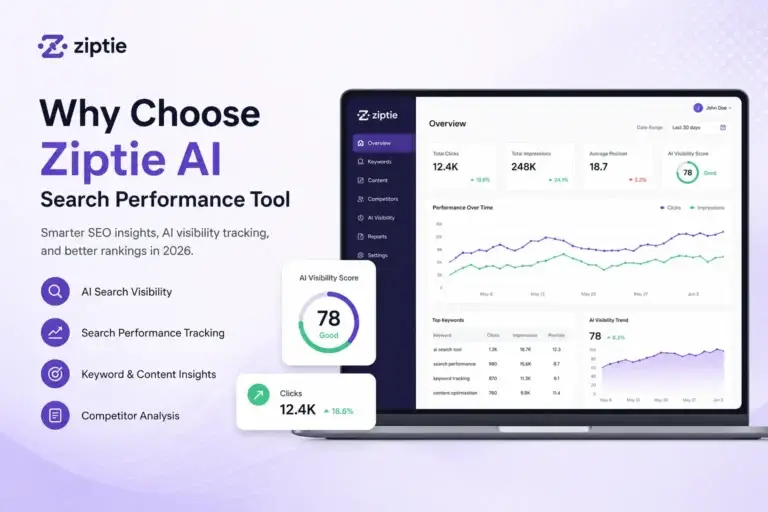
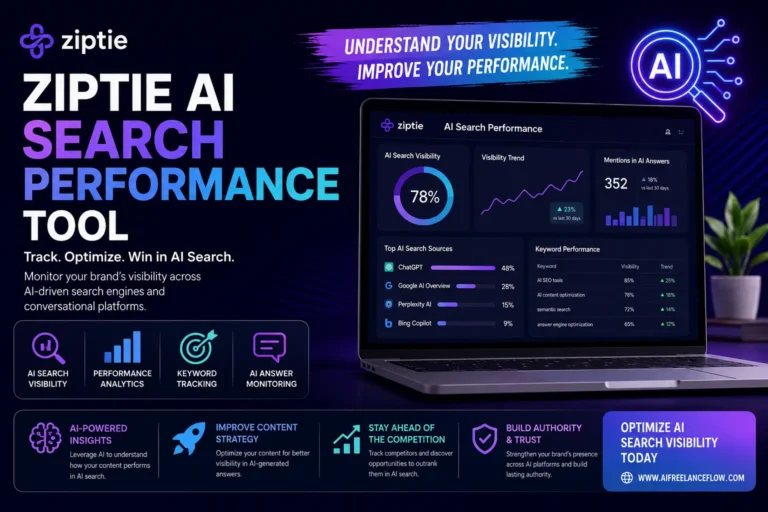
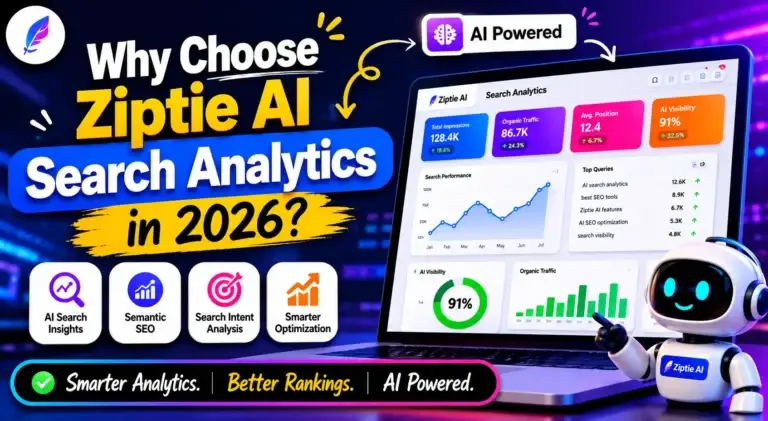
This is where platforms like Ziptie AI tool aim to help. Rather than focusing only on search engine rankings, Ziptie is designed to monitor and improve how brands appear across AI-generated search experiences. From a practical standpoint, that’s becoming increasingly valuable as AI search continues to grow.
That said, no optimization platform is perfect. The reality is usually less glamorous than marketing pages suggest. The effectiveness of any AI search optimization tool depends on your website quality, topical authority, content structure, and overall SEO strategy.
In this guide, we’ll take an objective look at how effective is Ziptie AI search optimization, examine its strengths and limitations, compare it with other solutions, and help you decide whether it’s the right investment for your business in 2026.
Table of Contents
- What Is Ziptie AI Search Optimization?
- Why AI Search Optimization Matters in 2026
- How Effective Is Ziptie AI Search Optimization?
- What Ziptie Does Well
- Where Ziptie Has Limitations
- Ziptie vs Traditional SEO Tools
- Step-by-Step Implementation
- Realistic 30-Day Example
- Pros and Cons
- Best Use Cases
- Common Mistakes to Avoid
- Expert Tips
- Future Trends
- Frequently Asked Questions
- Final Verdict
What Is Ziptie AI Search Optimization?
Unlike traditional SEO tools that primarily track Google rankings, backlinks, and keyword positions, Ziptie focuses on an entirely different layer of search visibility.
To understand how effective is Ziptie AI search optimization, you need to look at AI citations, brand mentions, and content authority together.
Its goal is to answer questions like:
- Is ChatGPT recommending your brand?
- Does Perplexity cite your website?
- How often do AI search engines mention your company?
- Which competitors appear more frequently in AI-generated answers?
- What content improvements could increase AI visibility?
As AI-powered search becomes more common, these questions are becoming just as important as traditional keyword rankings. You can also explore this deeper through Ziptie AI search performance tool and Ziptie SEO.
Traditional SEO vs AI Search Optimization
Search behavior is evolving quickly. A few years ago, most people searched like this: “best CRM software.” Today, users increasingly ask: “What’s the best CRM for a small marketing agency under $100 per month?”
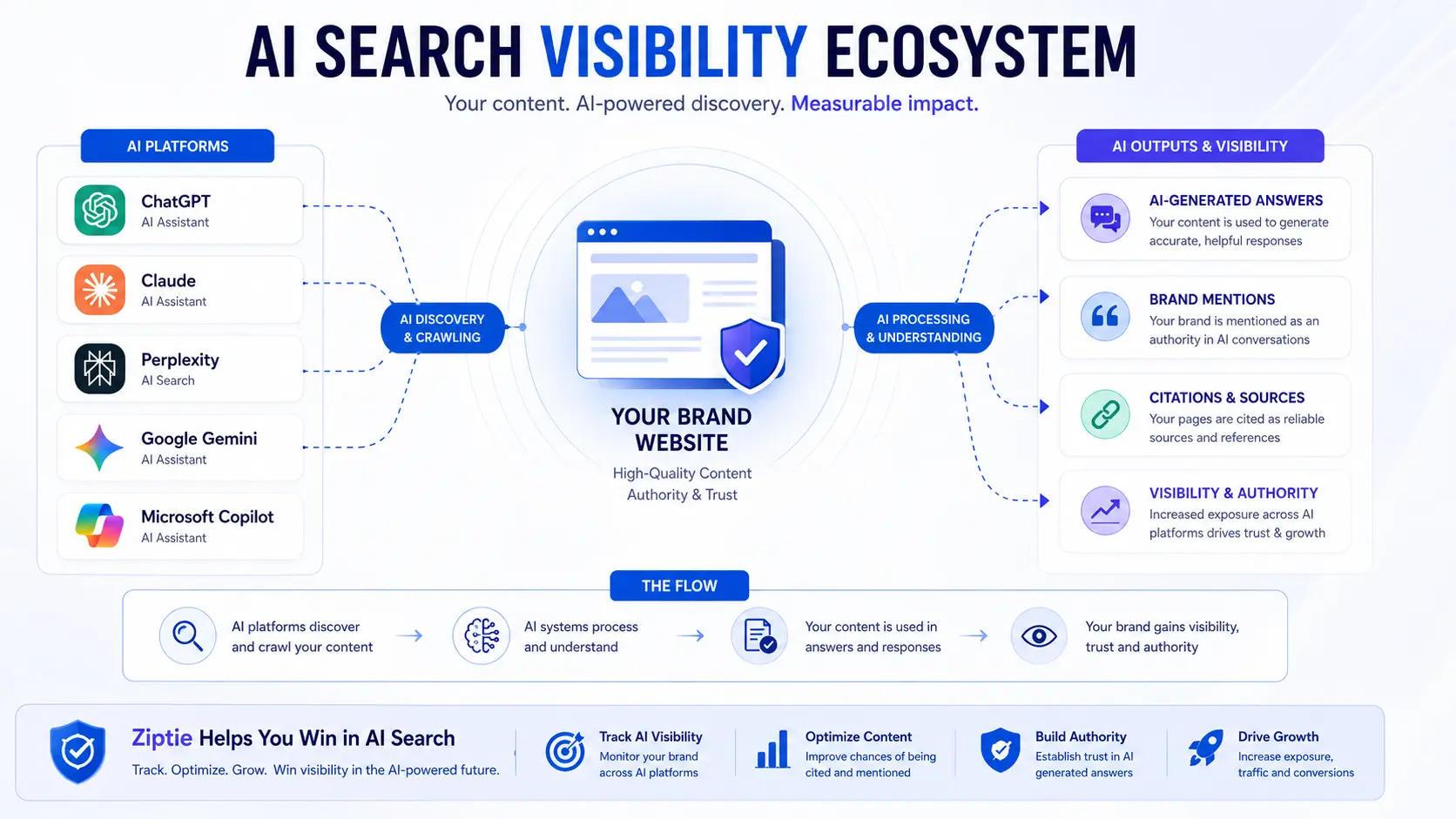
AI assistants don’t simply return a list of blue links. Instead, they generate complete answers by combining information from multiple trusted sources. That shift changes how websites earn visibility.
Instead of competing only for rankings, brands now compete to become trusted sources that AI systems reference. This is the problem Ziptie attempts to solve.
What Does Ziptie Actually Monitor?
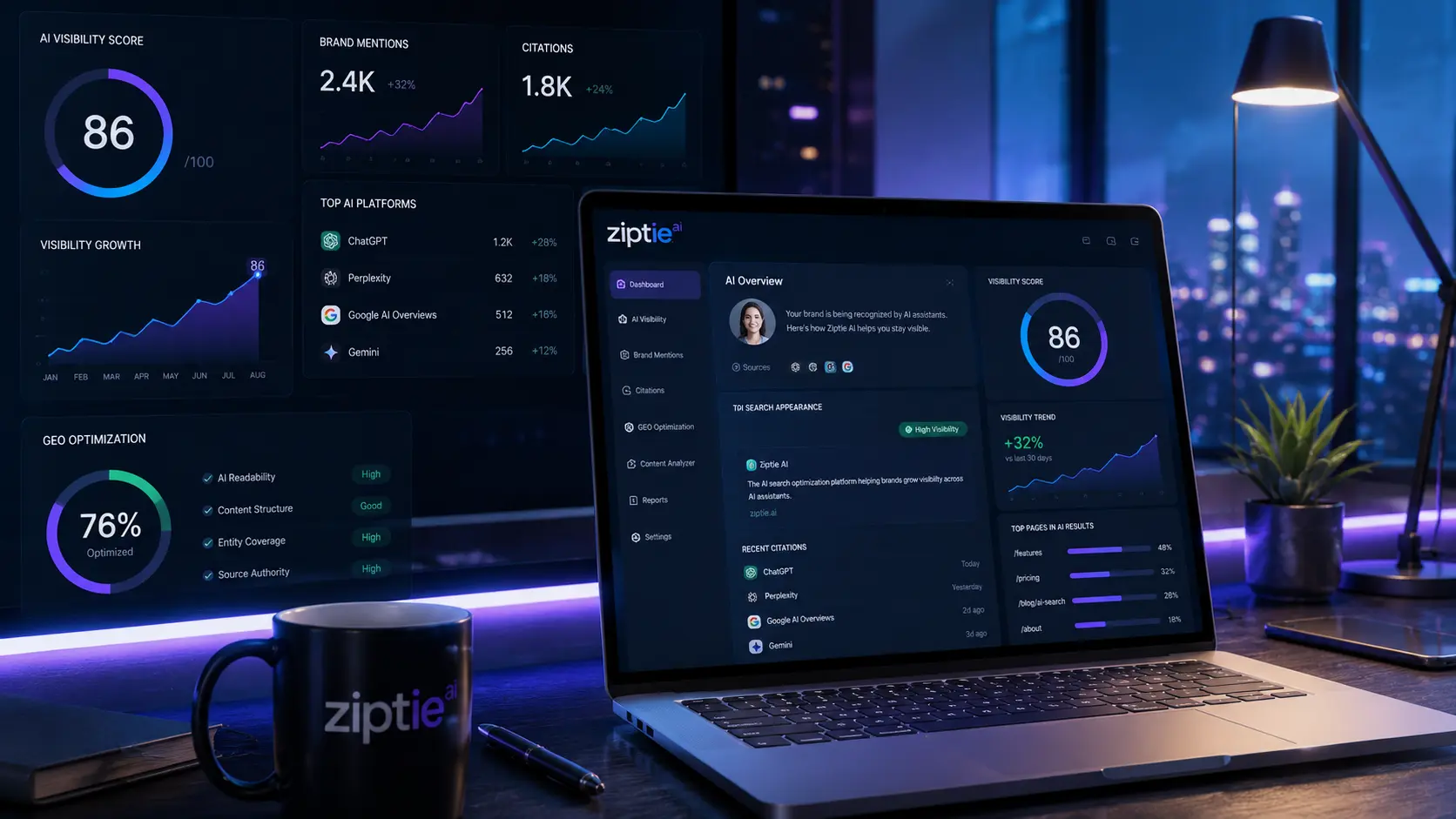
From publicly available information and product positioning, Ziptie focuses on several important visibility indicators:
- AI search visibility
- Brand mentions
- Citation frequency
- Competitive comparisons
- AI answer monitoring
- Content opportunities
- GEO, or Generative Engine Optimization
- AI search analytics
Rather than replacing your existing SEO platform, Ziptie is better viewed as an additional layer designed specifically for AI-powered search ecosystems.
Who Should Consider Ziptie?
Digital marketing agencies can monitor how client brands appear inside AI-generated search results. SaaS companies can track whether AI assistants mention their products during buying research. Content publishers can identify content gaps that may improve topical authority.
SEO professionals using platforms like Semrush, Google Search Console, or Google Analytics may find Ziptie useful because it offers a different perspective focused on AI-generated search experiences.
Why It Matters in 2026
One thing most beginners overlook is that AI search doesn’t replace SEO. Instead, it expands it.
Google Search remains essential. However, AI assistants increasingly summarize information instead of sending users directly to websites. That creates both challenges and opportunities.
If your content is consistently referenced by AI assistants, your brand gains credibility even when users never perform a traditional search. On the other hand, businesses that ignore AI optimization may gradually lose visibility as search behavior changes.
Another important factor is trust. AI systems tend to reference sources that demonstrate expertise, consistency, and topical authority. Simply publishing hundreds of articles isn’t enough. The content needs to answer questions clearly, stay up to date, and cover topics comprehensively.
This is where how effective is Ziptie AI search optimization becomes an important question. Rather than chasing search rankings alone, the platform aims to help businesses understand how AI models perceive their content across different AI search environments.
The real answer to how effective is Ziptie AI search optimization depends on whether your website already has strong content clusters and clear topical relevance.
For organizations investing heavily in AI SEO, content marketing, SaaS growth, AI automated income systems, or online business growth, that insight can become increasingly valuable over the next few years.
How Effective Is Ziptie AI Search Optimization?
Here’s the thing. Many people expect AI optimization software to magically increase traffic overnight. That isn’t how AI search works.
Unlike traditional SEO, where rankings often depend on backlinks and keyword optimization, AI search visibility is influenced by factors such as content quality, entity recognition, brand authority, citation consistency, structured information, website trust, and topic coverage.
For SaaS brands and SEO teams, how effective is Ziptie AI search optimization becomes easier to measure when AI visibility is tracked month by month.
Ziptie helps you understand these signals, but it can’t replace high-quality content or a strong SEO foundation. If your site is still weak technically, start with classic SEO basics first. Google’s own SEO Starter Guide is still useful for understanding crawlability, helpful content, and site structure.
If your content is thin or poorly structured, how effective is Ziptie AI search optimization will be limited until your SEO foundation improves.
What Ziptie Does Well
1. AI Brand Monitoring
One of the platform’s strongest features is monitoring brand mentions across AI search engines. Instead of wondering whether AI assistants recommend your company, you can measure your visibility across platforms like ChatGPT, Perplexity, Google Gemini, Microsoft Copilot, and Claude.
2. Competitive Benchmarking
Traditional SEO compares rankings. Ziptie compares AI visibility. You can understand which competitors appear most often, which brands receive citations, which topics competitors dominate, and where content gaps exist.
3. GEO Optimization
Generative Engine Optimization is becoming one of the fastest-growing SEO disciplines. Instead of optimizing only for Google rankings, GEO focuses on helping AI systems understand and reference your content.
4. Content Opportunity Discovery
Rather than guessing which articles to publish next, Ziptie helps identify areas where your topical authority could be improved. This supports content clusters, AI citations, entity coverage, knowledge gaps, and semantic relevance.
5. AI Search Analytics
Traditional SEO analytics explain what happened. AI search analytics attempt to explain why AI systems choose certain sources over others. Although this field is still evolving, having visibility into AI-generated search is becoming increasingly valuable.
Where Ziptie Has Limitations
AI Search Changes Constantly
AI models evolve rapidly. A recommendation visible today may disappear tomorrow after a model update. No platform can guarantee permanent visibility.
AI Results Are Not Fully Transparent
Unlike Google rankings, AI assistants rarely explain every source selection decision. Some recommendations are easier to analyze than others.
Not a Replacement for SEO
One mistake beginners make is assuming AI optimization replaces traditional SEO. It doesn’t. You still need technical SEO, internal linking, helpful content, fast website performance, structured data, and topical authority.
Better for Established Websites
Brand-new websites may see limited immediate value. Organizations already publishing high-quality content usually benefit more because AI systems already recognize their entities.
Ziptie vs Traditional SEO Tools
Another way to judge how effective is Ziptie AI search optimization is to compare your AI mentions against competitors in the same niche.
| Feature | Ziptie | Semrush | Google Search Console |
|---|---|---|---|
| Google Rankings | Limited | Excellent | Excellent |
| Keyword Research | Basic | Excellent | Limited |
| Backlink Analysis | No | Excellent | No |
| AI Visibility | Excellent | Limited | No |
| AI Citation Monitoring | Excellent | No | No |
| Competitor AI Analysis | Excellent | Limited | No |
| Technical SEO | Limited | Excellent | Good |
| GEO Optimization | Excellent | Limited | No |
You may benefit from Ziptie if you publish AI-related content regularly, manage SaaS websites, operate a digital agency, build topical authority, depend on content marketing, or want to understand AI-generated search.
If your only goal is finding keywords, fixing technical SEO, auditing backlinks, or tracking Google rankings, traditional SEO software may provide better value. The reality is slightly different for businesses focused on AI search. Many organizations now need both.
Step-by-Step Implementation
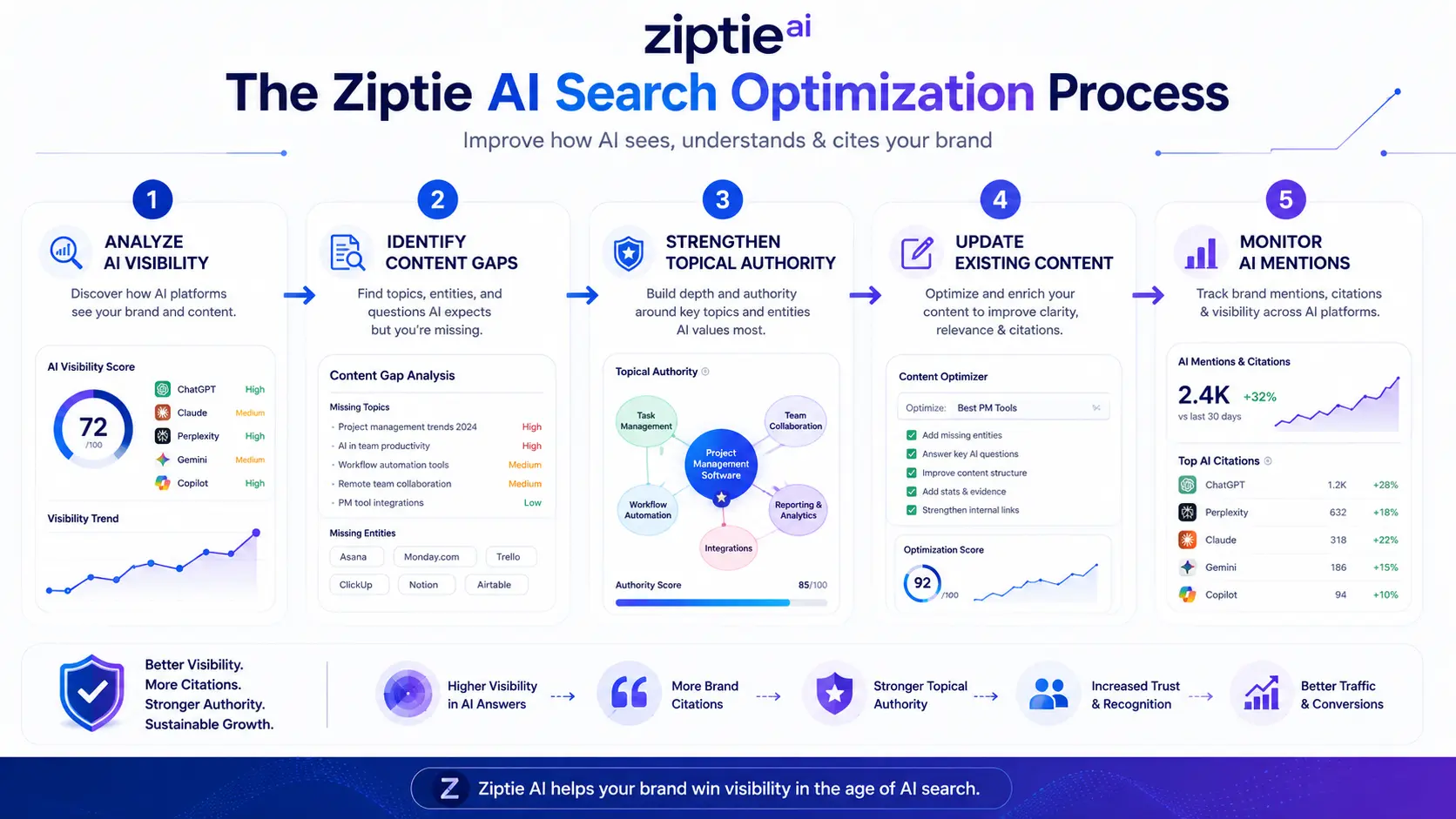
Step 1 — Analyze Current AI Visibility
Start by understanding where your brand already appears. Which AI assistants mention you? Which pages receive citations? Which competitors dominate? Don’t optimize before measuring.
Step 2 — Identify Content Gaps
Compare your website against competitors. Look for missing FAQs, weak entity coverage, outdated guides, thin content, and missing comparisons.
Step 3 — Strengthen Topical Authority
Instead of publishing unrelated articles, build complete topic clusters. For example: AI SEO → AI Search Optimization → GEO → AI Visibility → AI Citations → Brand Authority. AI assistants generally prefer websites that demonstrate deep expertise.
For content publishers, how effective is Ziptie AI search optimization often depends on consistent updates, internal links, FAQs, and strong entity coverage.
Step 4 — Improve Existing Content
Many websites publish new content every week while ignoring older articles. Updating existing articles often produces better long-term results. Review statistics, screenshots, examples, FAQs, comparison tables, and internal links.
Step 5 — Monitor AI Mentions
Optimization never really ends. Continue monitoring AI visibility, competitor mentions, citation frequency, and new opportunities. Small improvements accumulate over time.
Realistic 30-Day Example
This is an illustrative example and not a guarantee of results.
Imagine a SaaS company beginning its AI optimization journey.
- Week 1: Connect website, analyze AI visibility, and benchmark competitors.
- Week 2: Update pillar content, improve entity coverage, and add comparison tables.
- Week 3: Expand supporting articles, build internal links, and improve structured content.
- Week 4: Review AI mentions, measure visibility improvements, and plan the next content cluster.
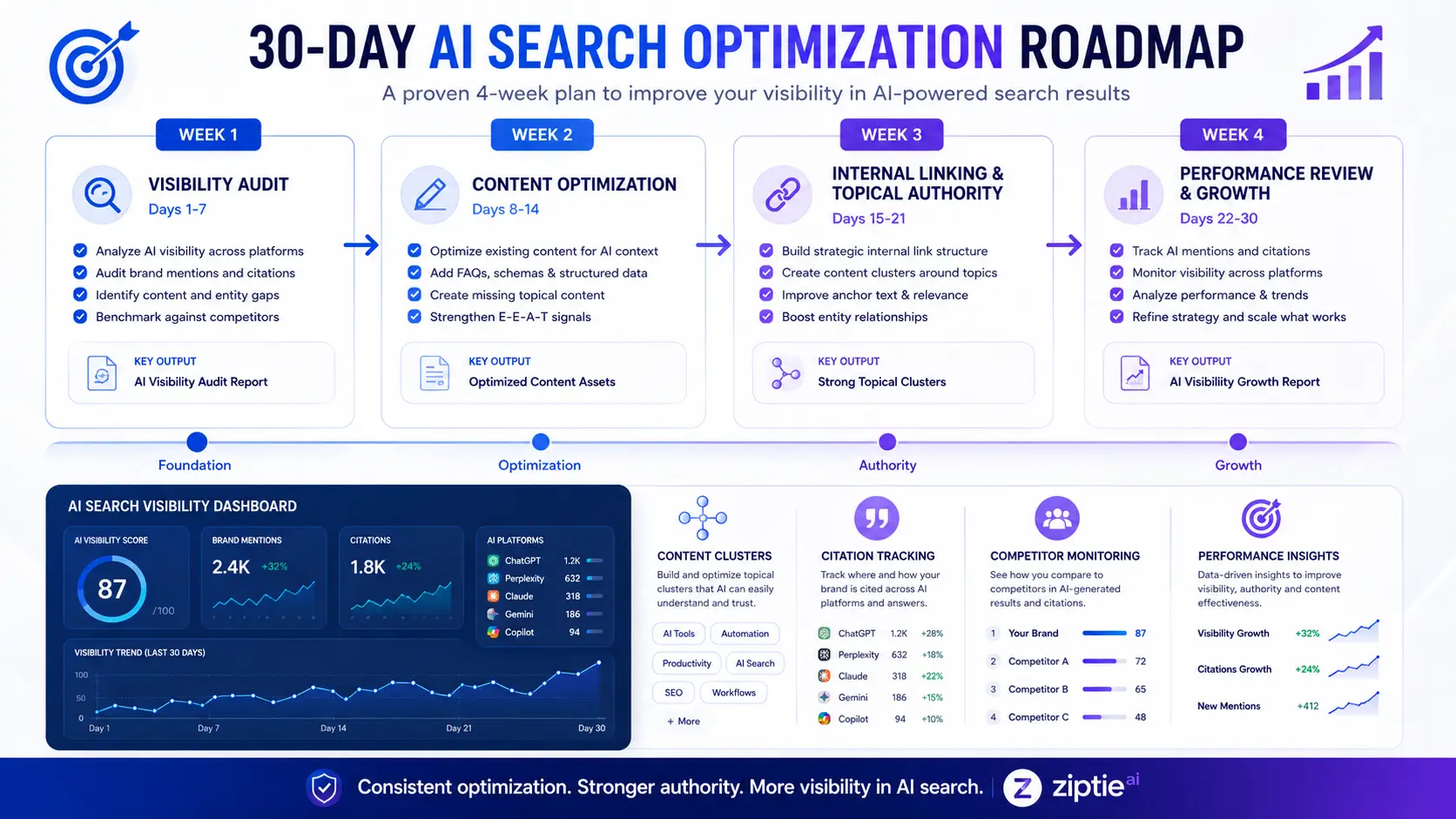
| Week | Primary Action | Expected Outcome |
|---|---|---|
| Week 1 | Visibility Audit | AI baseline established |
| Week 2 | Content Optimization | Better topical authority |
| Week 3 | Internal Linking | Stronger AI understanding |
| Week 4 | Performance Review | Identify new opportunities |
Imagine you’re managing an AI blog. Instead of publishing random articles, your monthly workflow could look like this: audit AI visibility using Ziptie, identify topics where competitors receive more AI citations, update one pillar article, publish two supporting articles, improve internal linking, refresh FAQs, and monitor AI visibility again.
This workflow won’t produce instant results, but it creates a stronger foundation for long-term AI search performance.
In practice, how effective is Ziptie AI search optimization is not about instant rankings, but about improving how AI engines understand and reference your brand.
From a practical standpoint, Ziptie delivers the most value when it’s integrated into an existing content strategy—not when it’s treated as a shortcut.
Pros and Cons of Ziptie AI Search Optimization
Pros
- AI visibility tracking
- Competitive insights
- GEO optimization
- Content gap discovery
- Brand monitoring
- Future-focused SEO perspective
Cons
- AI search optimization is still a new category
- Doesn’t replace traditional SEO
- Limited historical AI search data
- Better for established websites
- AI model updates can change visibility
Best Use Cases
- SaaS Companies: Excellent choice for software companies that rely on organic visibility.
- AI Startups: Useful for monitoring brand mentions as AI products gain market exposure.
- Content Publishers: Publishers building topical authority can discover new content opportunities.
- SEO Agencies: Agencies managing multiple clients can benchmark AI visibility and identify optimization opportunities.
- Enterprise Brands: Large organizations can monitor brand reputation across multiple AI-powered search environments.
Freelancers can also use this strategy when building AI SEO services, especially if they are already learning freelancing skills, using freelance websites, or creating offers around Upwork proposal automation.
Common Mistakes to Avoid
- Expecting Instant Results: AI optimization is a long-term strategy. Visibility improves gradually as authority grows.
- Ignoring Traditional SEO: You still need internal linking, helpful content, fast loading pages, schema markup, and crawlable architecture.
- Publishing Thin Content: AI assistants generally prefer comprehensive resources. One excellent guide usually outperforms several short articles.
- Ignoring Entity SEO: Entity relationships increasingly influence AI understanding. Mention relevant companies, technologies, products, and concepts naturally.
- Tracking Only Google Rankings: Traditional rankings tell only part of the story. AI visibility is becoming another important performance metric.
Expert Tips
After reviewing numerous AI SEO workflows, several practical recommendations consistently stand out.
Build Topic Clusters
Instead of writing isolated articles, create connected content. A cluster might include AI Search, AI SEO, Generative Engine Optimization, AI Visibility, Brand Mentions, and AI Search Analytics.
Update Existing Content
Refreshing strong articles often produces better long-term value than publishing dozens of new pages.
Monitor Competitors
Study AI citations, brand mentions, frequently referenced topics, and content depth. This helps identify opportunities that traditional keyword research may miss.
Combine Multiple Platforms
Ziptie works best alongside Google Search Console, Semrush, Google Analytics, and Ahrefs if available. Each platform provides different insights.
Prioritize Helpful Content
No AI optimization platform can compensate for poor content. Helpful, accurate, well-structured articles remain the foundation of AI visibility.
Future Trends
- AI Search Will Continue Growing: More users are asking questions directly to AI assistants.
- GEO Will Become Mainstream: Generative Engine Optimization is likely to become a standard part of SEO strategies.
- AI Citation Tracking Will Improve: Expect more sophisticated visibility analytics as AI search platforms mature.
- Brand Authority Will Matter More: AI assistants increasingly favor trusted, authoritative websites.
- Traditional SEO and AI SEO Will Merge: AI optimization will become another layer of search optimization.
This also connects with wider AI business trends. If you are building income systems around content, review how AI companies make money, AI money-making strategies, free AI tools to make money online, and how to make passive income with AI.
Frequently Asked Questions
1. How effective is Ziptie AI Search Optimization?
It can be effective for businesses that want to monitor and improve AI search visibility alongside their existing SEO strategy.
2. Does Ziptie replace Semrush?
No. Semrush focuses primarily on traditional SEO, while Ziptie specializes in AI search visibility.
3. Is Ziptie suitable for beginners?
Yes. However, users with a basic understanding of SEO will likely gain more value from the platform.
4. Does Ziptie improve Google rankings?
Not directly. Its primary purpose is improving visibility within AI-powered search environments.
5. Which businesses benefit most?
SaaS companies, agencies, AI startups, publishers, and brands investing heavily in content marketing.
6. Can freelancers use Ziptie?
Yes. Freelancers offering AI SEO or content strategy services may find it useful for competitive analysis.
7. Is AI search optimization replacing SEO?
No. AI search optimization complements traditional SEO rather than replacing it.
8. Should small businesses invest in Ziptie?
If AI-generated search traffic is becoming important for your industry, it may be worth evaluating alongside your existing SEO tools.
9. How long does it take to see results?
There is no guaranteed timeline. Results depend on your content quality, authority, and implementation strategy.
10. Is Ziptie worth trying in 2026?
For businesses that want to prepare for the future of AI search, it can be a valuable addition to an existing SEO workflow, provided expectations remain realistic.
Final Verdict
Artificial intelligence is transforming how people discover information online, and AI-powered search is becoming an increasingly important traffic source. If you’re wondering how effective is Ziptie AI Search Optimization, the answer is that it offers meaningful value for businesses focused on understanding and improving their visibility in AI-generated search experiences.
Overall, how effective is Ziptie AI search optimization comes down to using the tool as part of a complete AI SEO strategy, not as a shortcut.
Its biggest strengths are AI visibility monitoring, competitive insights, and support for Generative Engine Optimization. Rather than replacing traditional SEO platforms, Ziptie complements tools like Google Search Console and Semrush by helping you understand how AI assistants reference your content.
That said, success doesn’t come from software alone. High-quality content, strong topical authority, technical SEO, and a thoughtful internal linking strategy remain the foundation of long-term search performance.
If your goal is to future-proof your content strategy as AI search continues to evolve, Ziptie is worth considering as part of a broader SEO toolkit—not as a standalone solution.
Ready to Improve Your AI Search Visibility?
As AI search continues to reshape digital marketing, combining strong content with the right optimization tools can help your website stay competitive.
Explore more guides on Ziptie AI tool, why choose Ziptie AI search analytics, Ziptie SEO, best AI tools for freelancers, best AI side hustles, and future of AI to build a strategy that works for both traditional search engines and the next generation of AI-powered search.