How to Make Money with AI Art in 2026: The Realistic Playbook
Artificial intelligence has completely changed the creative industry.
Only a few years ago, creating professional digital artwork required years of drawing experience, expensive software, or hiring skilled designers. Today, AI image generators allow almost anyone to turn an idea into a polished illustration, marketing graphic, printable product, or concept design within minutes.
That change has created an entirely new business opportunity.
Instead of asking whether AI can create images, more people are now asking a far more practical question: how to make money with AI art?
The short answer is yes, you can. But here’s the thing: most YouTube videos and social media posts make it look much easier than it actually is.
They often show screenshots of large sales or passive income dashboards without explaining everything happening behind the scenes: niche research, keyword optimization, prompt engineering, editing, branding, customer psychology, marketplace SEO, Pinterest marketing, and product packaging.
The reality is usually different. Creating an image is now the easiest part of the process. Building a business around those images is where the real work begins.
One thing most beginners overlook is that customers rarely buy “AI art.” Instead, they buy solutions. They buy printable nursery decorations. They buy wedding invitations. They buy productivity planners. They buy book covers. They buy social media graphics. They buy branding assets.
The image itself simply becomes the vehicle that solves a problem.
That shift in mindset changes everything. If you approach AI art as a business instead of a toy, you will immediately make better decisions.
Throughout this guide, you will learn how to make money with AI art using practical, realistic strategies rather than unrealistic promises. We will cover monetization models, compare AI tools, discuss mistakes, explain licensing considerations, and build a roadmap you can actually follow.
If your goal is broader online income, this topic connects naturally with how to make money online, AI side hustles, AI passive income, and 100 ways to make money with AI in 2026.
Table of Contents
What Is AI Art? Why AI Art Matters in 2026 Can You Really Make Money with AI Art? Who Should Build an AI Art Business? The AI Art Opportunity Most Beginners Miss The 15 Best Ways to Make Money with AI Art Best AI Image Generators Compared Hidden Costs Most Beginners Ignore Step-by-Step Blueprint 30-Day and 90-Day Roadmap Pinterest SEO Blueprint AI Art, Blogging, SEO, and Affiliate Marketing Common Mistakes FAQ Final VerdictWhat Is AI Art?
Quick Answer: AI art refers to images generated or enhanced using artificial intelligence models that create visuals from text prompts, sketches, reference images, or editing instructions.
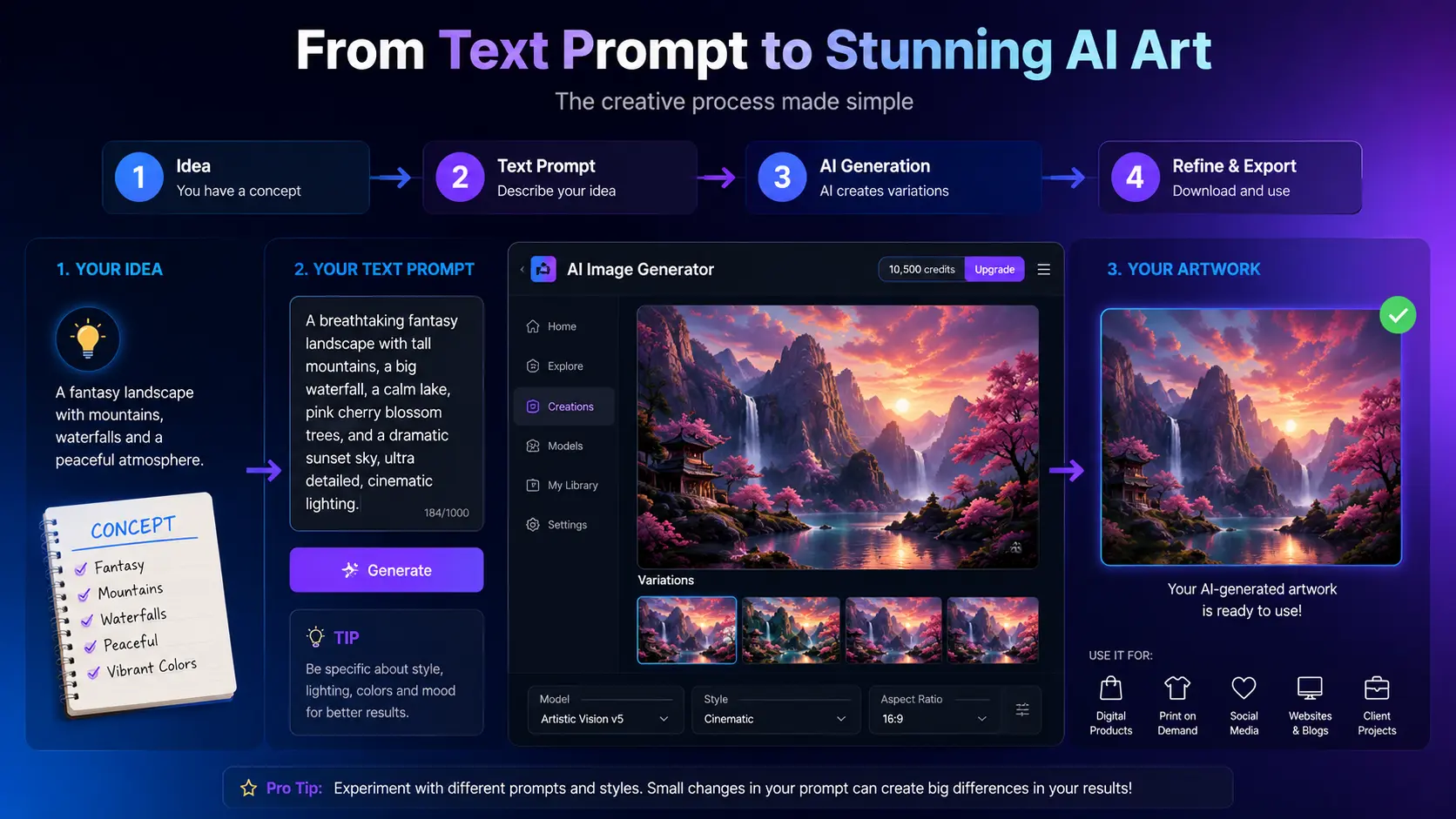
AI art generators analyze enormous datasets to understand lighting, perspective, colors, artistic styles, composition, textures, objects, typography, and design patterns. When you write a prompt, the AI predicts what the requested image should look like and generates a new visual.
Modern generators can create realistic portraits, fantasy artwork, product mockups, children’s illustrations, concept art, business graphics, social media visuals, YouTube thumbnails, Pinterest graphics, printable wall art, educational worksheets, coloring pages, and book cover concepts.
However, AI does not replace creativity. Instead, it changes where creativity happens.
Rather than spending six hours drawing one illustration, creators now spend more time researching niches, writing prompts, selecting outputs, editing details, improving composition, packaging products, optimizing listings, and marketing their work.
This distinction is important because businesses pay for useful results, not the amount of time spent creating them.
Why AI Art Matters in 2026
Quick Answer: AI art matters because businesses need more visual content than ever before, while AI dramatically reduces the time required to produce it.
Visual content demand continues growing across nearly every industry. Bloggers need featured images, infographics, Pinterest graphics, and social media images. Ecommerce stores need product mockups, advertising creatives, and banners. Coaches need worksheets and presentation graphics. Authors need book covers. Businesses need advertisements, landing page visuals, and social media campaigns.
AI helps produce these assets faster than traditional workflows. But speed alone is not the advantage. The biggest advantage is flexibility.
A single AI illustration can become an Etsy printable, a Pinterest Pin, a Facebook graphic, an Instagram post, a blog illustration, a YouTube thumbnail, a lead magnet, an ebook cover, or a product mockup.
Instead of producing one asset for one purpose, modern creators reuse visual assets across multiple platforms. That dramatically increases the value of every image you create.
This is also why AI art connects well with AI tools for content creation, top AI tools, and the future of AI.
Can You Really Make Money with AI Art?
Quick Answer: Yes, but not simply because you use AI. You make money because you solve problems.
Many beginners assume the process looks like this:
- Generate AI image
- Upload it online
- Wait for sales
Unfortunately, it rarely works that way.
Successful creators usually combine AI image generation with SEO, product research, branding, Pinterest marketing, copywriting, customer psychology, and marketplace optimization.
From a practical standpoint, AI becomes your production assistant, not your business.
AI images are becoming easier to create every month. That means image generation itself is becoming less valuable. What becomes more valuable is knowing what customers want, how to package products, where to sell, how to attract traffic, and how to build trust.
Those skills remain difficult to automate. That is actually good news. It means beginners willing to learn marketing still have a genuine opportunity.
Who Should Build an AI Art Business?
AI art tends to work especially well for bloggers, freelancers, Etsy sellers, print-on-demand businesses, Pinterest creators, affiliate marketers, YouTubers, coaches, and small agencies.
Bloggers need visual assets for every article. Freelancers can offer graphics without hiring illustrators. Etsy sellers can create printable products. Print-on-demand businesses can design apparel, mugs, posters, and accessories. Pinterest creators can produce visual content that drives long-term traffic.
If you are starting from zero, read how to start freelancing with no experience and best freelancing skills to learn. These skills pair naturally with AI design services.
One thing worth remembering is that AI art is rarely the business by itself. Instead, it strengthens another business. That is why many experienced creators combine AI-generated artwork with blogging, freelancing, digital products, SEO, automation, and affiliate marketing rather than relying on image sales alone.
The AI Art Opportunity Most Beginners Miss
Most new creators spend almost all of their time improving prompts. Professional creators spend much more time improving products.
Those are completely different activities.
A beginner might create: “beautiful fantasy castle.”
An experienced seller creates: “30 Printable Fantasy Nursery Wall Art Bundle with Matching Color Palette, Instant Download, Neutral Kids Bedroom Decor.”
Notice the difference?
The second product solves a specific problem for a specific customer. That is what creates value.
Learning how to make money with AI art is really about learning how to identify valuable problems and use AI to solve them efficiently.
The 15 Best Ways to Make Money with AI Art
Quick Answer: The most sustainable approach is to combine several income streams instead of relying on a single platform. AI-generated artwork can become digital products, freelance services, marketing assets, stock images, or content that attracts long-term traffic.
1. Sell Printable Digital Downloads
For beginners, printable products remain one of the easiest entry points. Instead of selling physical products, you sell downloadable files that customers print themselves.
Popular products include wall art, wedding invitations, baby shower templates, planner pages, calendars, journal inserts, classroom worksheets, vision boards, affirmation cards, and budget planners.
Best platforms include Etsy, Gumroad, Creative Market, and Creative Fabrica.
Competition is increasing, so niche selection and product quality matter more than ever.
2. Print-on-Demand Products
Print-on-demand allows you to sell physical products without holding inventory. After a customer places an order, the supplier prints and ships the item.
Popular products include hoodies, T-shirts, posters, canvas prints, coffee mugs, phone cases, tote bags, mouse pads, stickers, and notebooks.
Popular platforms include Printify, Printful, Redbubble, and Society6.
One thing many beginners overlook is that generic AI artwork rarely sells well. Stores with a recognizable style tend to perform better over time.
3. Offer AI Design Services
Instead of selling products, you can sell your skills. Businesses increasingly need blog illustrations, Pinterest graphics, YouTube thumbnails, presentation slides, website banners, product mockups, ebook covers, and social media graphics.
Clients usually care more about quality than the software used to create the first draft. If you deliver polished work consistently, AI simply becomes part of your workflow.
You can find client work through Fiverr, Upwork, and other best websites for freelancers.
4. Sell AI Prompt Libraries
Not everyone wants finished artwork. Many creators want high-quality prompts.
Examples include Midjourney prompt packs, ChatGPT image prompt libraries, Leonardo AI prompt collections, Canva prompt templates, fantasy prompt bundles, and product photography prompt packs.
Prompt libraries require research and testing, but they scale well because they are digital products.
5. Publish AI Coloring Books
Coloring books continue to perform well in many niches. Examples include animals, flowers, dinosaurs, fantasy creatures, educational books, holiday themes, and mindfulness books.
Many creators publish them through Amazon KDP. AI speeds up production, but every page should still be reviewed carefully for quality.
6. Create Book Covers
Independent authors constantly need affordable covers. AI is excellent for concept generation, background illustrations, character ideas, fantasy landscapes, and science fiction scenes.
Final editing usually includes typography, layout adjustments, and branding. The AI image is only one part of the finished product.
7. Sell Stock Images
Some stock platforms accept AI-generated artwork under specific licensing rules. Adobe Stock is one example, but policies can change, so always check current platform rules before uploading.
Common categories include business, healthcare, technology, education, finance, remote work, artificial intelligence, and productivity.
Rather than uploading random images, create themed collections. Collections tend to perform better than isolated uploads.
8. Create Pinterest Graphics
Pinterest remains one of the strongest visual search engines. Businesses often need blog Pins, product Pins, infographics, carousel graphics, and seasonal Pins.
Instead of selling one graphic, package your services. For example, offer 10 Pinterest Pins, matching Canva templates, SEO titles, and Pin descriptions. That package provides much more value than selling images individually.
9. Design Marketing Assets
Small businesses frequently need flyers, advertisements, restaurant menus, event posters, website headers, Facebook Ads, Instagram creatives, and LinkedIn banners.
AI dramatically speeds up concept generation while still allowing customization.
10. Build an AI Art Membership
Instead of one-time sales, create recurring revenue. Members might receive weekly artwork, monthly design packs, prompt libraries, commercial licenses, printable bundles, and exclusive templates.
Membership businesses generally grow slowly but can become more stable over time.
11. Sell Digital Asset Bundles
Bundles increase perceived value. Examples include 100 AI backgrounds, 50 watercolor prints, 200 social media graphics, 75 product mockups, and 150 printable designs.
Bundles also work well for Pinterest because they provide multiple promotional angles.
12. Create AI Art for Bloggers
Bloggers constantly need featured images, comparison graphics, workflow diagrams, infographics, and Pinterest Pins.
Offering complete visual packages often commands higher prices than selling standalone images.
13. Sell AI Templates
Templates save customers time. Popular examples include Canva templates, social media kits, business presentations, printable planners, digital journals, and lead magnets.
Customers buy convenience as much as design.
14. License Commercial AI Artwork
Instead of selling ownership, license your artwork. Potential buyers include marketing agencies, SaaS companies, publishers, bloggers, and ecommerce stores.
Licensing can create additional revenue from the same asset.
15. Build a Complete AI Content Business
This is arguably the strongest long-term strategy. Instead of selling artwork directly, use AI-generated visuals to support blogging, affiliate marketing, Pinterest, email marketing, freelancing, digital products, and online courses.
One blog article can generate organic Google traffic, Pinterest traffic, affiliate commissions, email subscribers, digital product sales, and freelance inquiries.
This creates a diversified business rather than relying on a single marketplace. It connects naturally with AI money making, free AI tools to make money online, passive earnings with AI, and the AI revolution and making money.
AI Art Income Comparison
| Method | Startup Cost | Difficulty | Scalability | Long-Term Potential |
|---|---|---|---|---|
| Digital Downloads | Low | Easy | High | Very High |
| Print-on-Demand | Low | Easy | High | High |
| Freelancing | Very Low | Medium | Medium | Very High |
| Prompt Packs | Very Low | Easy | High | High |
| Stock Images | Low | Medium | Medium | Medium |
| Coloring Books | Low | Medium | High | High |
| Book Covers | Low | Medium | Medium | High |
| Membership | Medium | Hard | Very High | Very High |
| Content Business | Medium | Hard | Very High | Very High |
This table is educational only. It is not a guarantee of results.
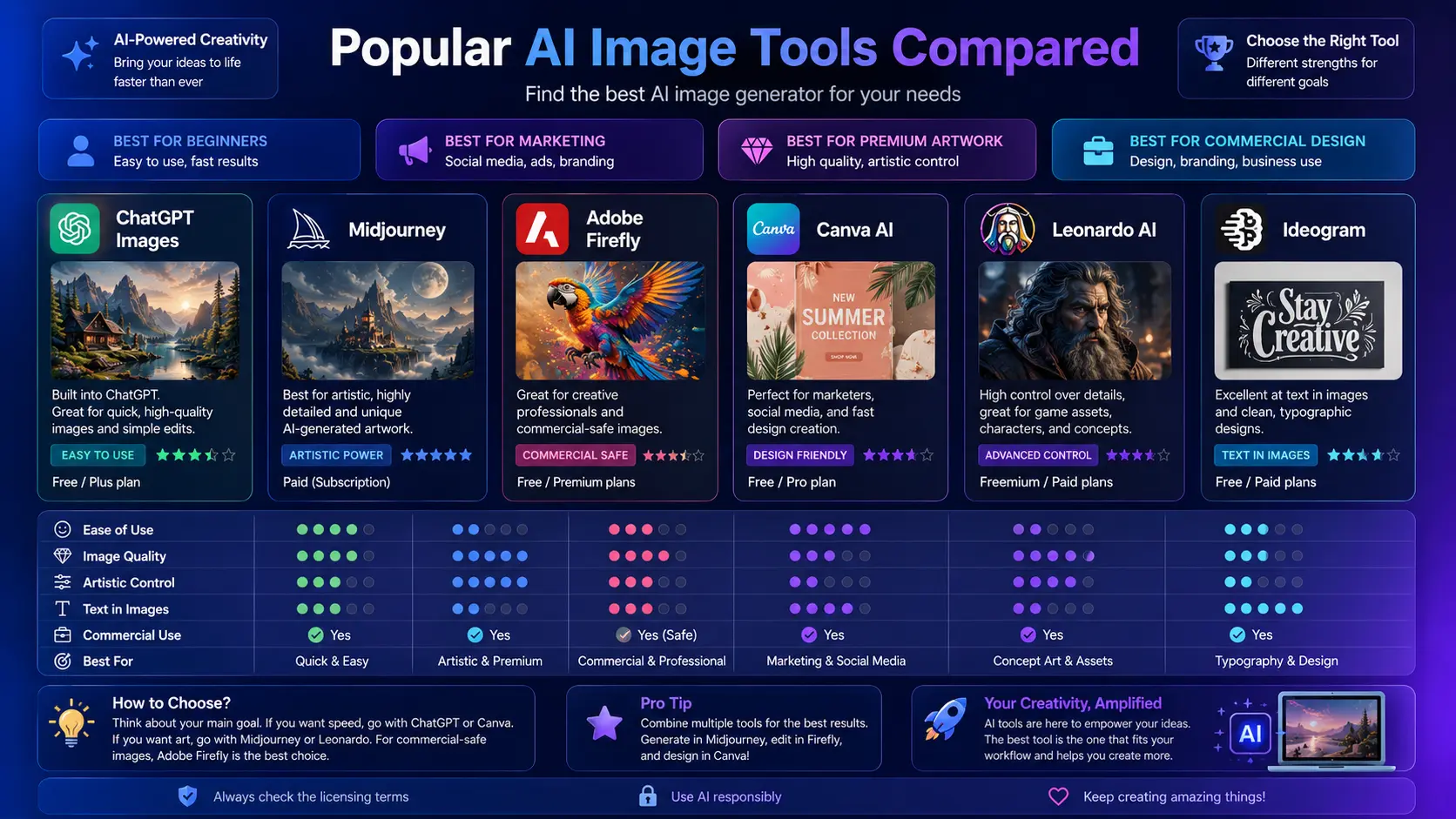
Best AI Image Generators Compared
| Tool | Best For | Learning Curve | Commercial Use | Best Choice For |
|---|---|---|---|---|
| ChatGPT Images | Fast concepts | Easy | Check plan terms | Beginners |
| Midjourney | Premium artwork | Medium | Subscription terms apply | Artists and print sellers |
| Adobe Firefly | Commercial graphics | Easy | Adobe licensing | Businesses |
| Canva AI | Marketing visuals | Very Easy | Canva licensing | Bloggers and marketers |
| Leonardo AI | Detailed illustrations | Medium | Platform terms apply | Designers |
| Ideogram | Text in images | Easy | Platform terms apply | Posters and branding |
For a wider tool strategy, you can also compare best AI tools for freelancers, best free AI tools for human resources, AI human resources courses, and Drovenio AI tools if your content strategy covers multiple AI categories.
Hidden Costs Most Beginners Ignore
Many articles focus only on AI tools. In practice, there are additional costs: premium AI subscriptions, mockup software, domain name, website hosting, Canva Pro, marketplace fees, payment processing fees, optional advertising, and time spent learning.
These costs do not make AI art unprofitable, but they are worth planning for.
Beginner vs Professional Strategy
| Beginner | Professional |
|---|---|
| Learn one AI tool | Build repeatable workflows |
| One marketplace | Multiple revenue streams |
| Small portfolio | Recognizable brand |
| Simple products | Product ecosystems |
| Organic traffic | SEO + Pinterest + Email + Social |
Step-by-Step Blueprint: How to Make Money with AI Art
Quick Answer: The fastest path is not creating thousands of AI images. It is building a repeatable system that transforms ideas into products, attracts traffic, and converts visitors into customers.
Phase 1 — Research Before You Create
Most beginners start with image generation. Professionals usually start with research.
Before opening Midjourney, ChatGPT Images, Adobe Firefly, or Leonardo AI, answer these questions:
- Who is the customer?
- What problem are they trying to solve?
- What style is currently popular?
- What keywords are people searching for?
- Who are the top competitors?
- Can I improve on existing products?
A simple 30-minute research session often saves hours of creating artwork nobody wants.
Phase 2 — Validate Demand
Do not guess. Validate. Check platforms like Etsy, Creative Market, Pinterest, Amazon KDP, Adobe Stock, Fiverr, and Upwork.
Look for products with reviews, consistent demand, evergreen topics, and room for improvement. One thing most beginners overlook is that you do not need a brand-new idea. You need a better implementation.
Phase 3 — Create a Product Ecosystem
Instead of making one product, build an ecosystem.
Example: AI wall art collection → printable bundle → Pinterest Pins → blog article → lead magnet → email newsletter → affiliate recommendations → premium bundle → membership.
One design becomes multiple assets. That is how experienced creators increase ROI.
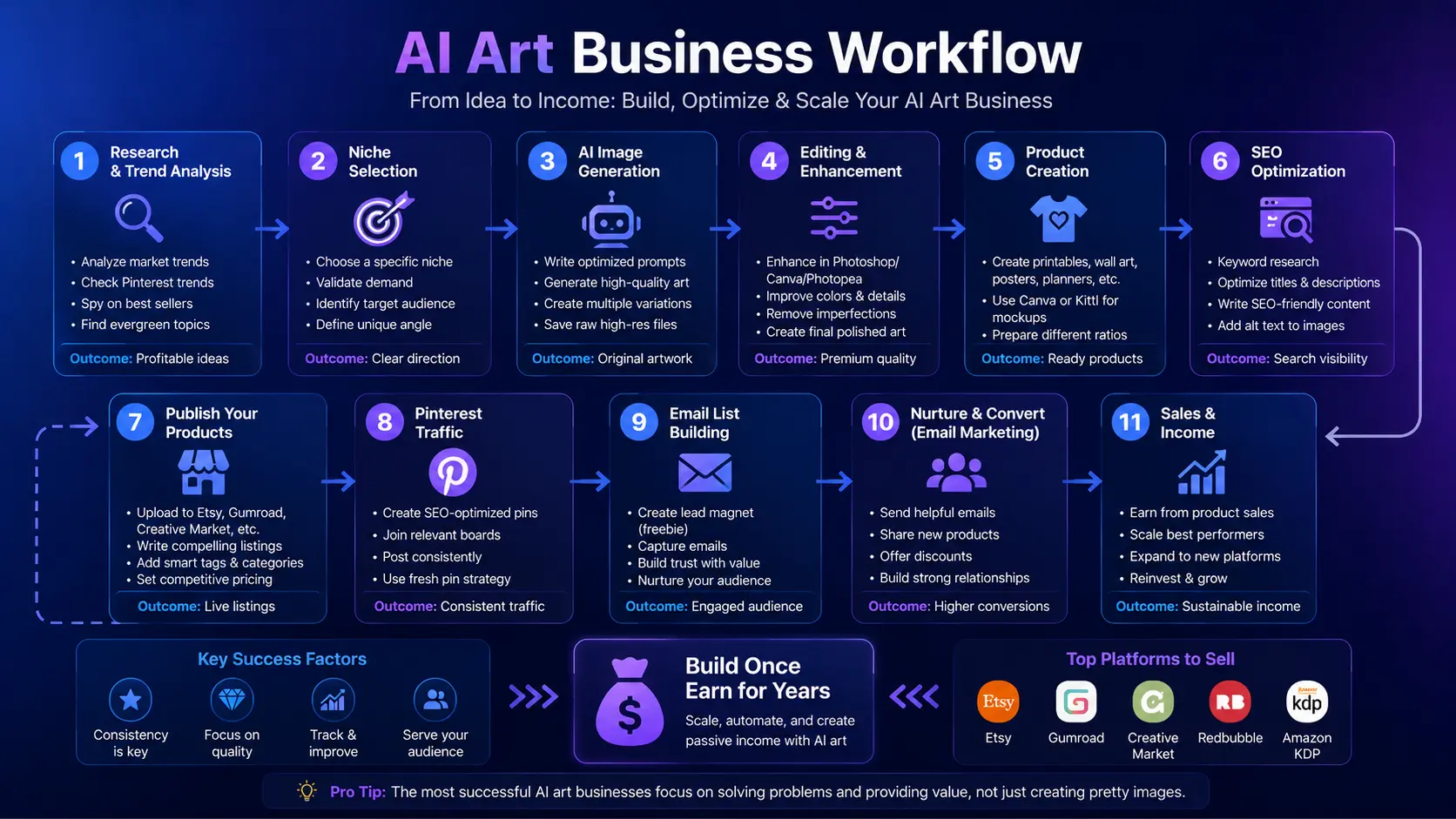
The AI Art Business Framework
| Research |
| Choose Niche |
| Generate Images |
| Edit |
| Create Products |
| Optimize SEO |
| Publish |
| Google Traffic |
| Email List |
| Repeat |
Generating the image is only one step. Marketing is the larger part of the workflow.
Your First 30 Days
This is an illustrative example and not a guarantee of results.
| Week | Focus | Tasks | Deliverable |
|---|---|---|---|
| Week 1 | Learn and research | Learn one AI tool, study competitors, pick one niche, write prompts, generate 50–100 images | A small polished portfolio |
| Week 2 | Build products | Create 10 printable products, 5 Pinterest templates, 3 prompt packs, mockups, SEO titles, descriptions | First product collection |
| Week 3 | Launch | Publish on Etsy, Gumroad, your website, and Pinterest | Live listings and traffic assets |
| Week 4 | Optimize | Review clicks, saves, sales, traffic, conversion rate, titles, mockups, pricing, and keywords | Improved products and process |
Weekly Workflow
| Day | Main Activity | Outcome |
|---|---|---|
| Monday | Keyword research | Product ideas |
| Tuesday | AI generation | New assets |
| Wednesday | Editing | Premium visuals |
| Thursday | Product creation | Listings |
| Friday | Pinterest content | Traffic assets |
| Saturday | Blog content | SEO growth |
| Sunday | Analytics | Optimization |
Scaling Strategy
Many creators stay stuck because they never move beyond one income source. A better roadmap looks like this:
- Stage 1: Digital downloads
- Stage 2: Print-on-demand
- Stage 3: Freelancing
- Stage 4: Blog
- Stage 5: Pinterest
- Stage 6: Affiliate marketing
- Stage 7: Membership
- Stage 8: Automation
Each stage supports the next. For automation ideas, explore AI automated income systems, AI passive income generators, and how to make money with AI for free.
Pinterest SEO Blueprint for AI Art
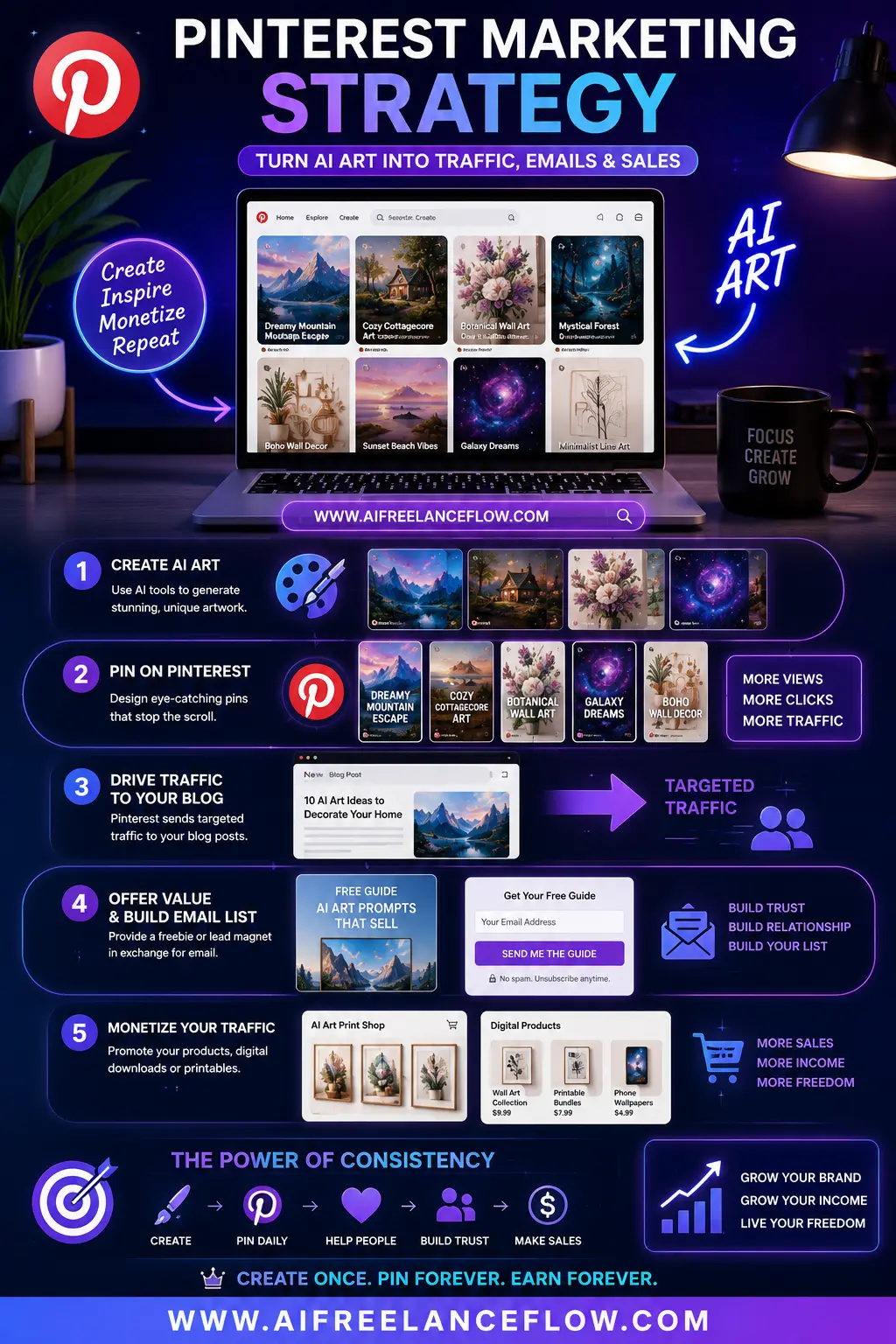
Quick Answer: Pinterest is one of the best long-term traffic sources for AI art because users search for inspiration before they buy. Unlike most social platforms, a high-quality Pin can continue driving traffic for months or even years.
One thing many creators misunderstand is that Pinterest is not primarily a social network. It behaves much more like a visual search engine.
People visit Pinterest with intent. They search for printable wall art, nursery decor, coloring pages, digital planners, AI business ideas, home office inspiration, Etsy products, digital downloads, passive income ideas, and small business marketing.
Your AI-generated visuals naturally fit those searches. Instead of interrupting someone with an ad, Pinterest lets you appear while they are already looking for inspiration.
The Pinterest Traffic Flywheel
| Keyword Research |
| Create AI Artwork |
| Create Product |
| Write Blog Article |
| Design Pinterest Pins |
| Pinterest Traffic |
| Website Visitors |
| Email Subscribers |
| Affiliate Sales |
| Digital Product Sales |
| Repeat |
Pinterest SEO Framework
- Strong title: Use “How to Make Money with AI Art: Beginner Guide” instead of “AI Art.”
- Keyword-rich description: Describe the problem, the solution, and who it is for.
- High-quality image: Use vertical images, clean typography, strong contrast, readable titles, and minimal clutter.
- Relevant board: Publish to boards like AI Side Hustles, AI Business, Digital Products, AI Marketing, Printable Wall Art, Etsy Business, and Passive Income.
- Consistency: Publishing 3–5 fresh Pins weekly often performs better than uploading 50 Pins in one day.
AI Art + Blogging + Affiliate Marketing
One of the biggest mistakes is separating your blog from your products. Instead, connect everything.
A blog article can become a featured image, Pinterest Pins, infographic, email newsletter, digital product, affiliate recommendation, YouTube video, and social media post.
Many creators believe AI art itself must generate all the income. That is rarely necessary. AI artwork can support affiliate content.
For example, an article about the best AI image generators can include custom comparison graphics, Pinterest Pins, affiliate links, organic traffic, and commissions. The artwork increases engagement while affiliate products generate revenue.
If you focus on AI SEO, you may also connect this topic with Ziptie AI Tool, Ziptie AI Search Performance Tool, Ziptie SEO, Ziptie AI Search Analytics, and Ziptie AI Search Optimization effectiveness.
AI Art + Email Marketing
Traffic is valuable. Subscribers are even more valuable.
Offer something useful such as a free prompt pack, printable bundle, AI wallpaper collection, Canva templates, or AI design checklist.
Visitors download it, join your email list, receive future offers, and return to your website. An email list gives you a way to stay connected without relying entirely on search engines or social media.
ROI Decision Matrix
| Activity | Time Investment | Cost | Long-Term ROI | Recommended for Beginners |
|---|---|---|---|---|
| Learning prompts | Medium | Low | High | Yes |
| Digital downloads | Medium | Low | High | Yes |
| Print-on-demand | Medium | Low | Medium | Yes |
| Freelancing | Medium | Very Low | High | Yes |
| Medium | Low | Very High | Yes | |
| Blogging | High | Medium | Very High | Yes |
| Affiliate marketing | High | Low | Very High | Later |
| Membership | High | Medium | High | Advanced |
Advanced Mistakes Even Experienced Creators Make
Chasing Every New AI Tool
New tools appear constantly. Instead of switching every week, focus on mastering one workflow. A reliable system usually beats constant experimentation.
Ignoring Branding
Strong branding helps customers recognize your work. Think about visual style, color palette, product naming, tone of voice, and store presentation.
Publishing Without Analytics
Review your data regularly. Which products receive the most clicks? Which Pins drive the most traffic? Which blog posts attract visitors? Which designs convert best?
Forgetting Customer Intent
Do not ask, “What do I want to create?” Ask, “What does my customer need?” That small shift often leads to better products and stronger marketing.
Information Gain: What Many AI Art Guides Miss
A common misconception is that success comes from generating better images. In reality, image quality is only one piece of the puzzle.
Long-term success usually depends on understanding customer intent, building a recognizable niche, creating reusable product systems, repurposing content across multiple channels, improving listings through data rather than guesswork, and diversifying traffic sources so you are not dependent on one platform.
Treat AI as a productivity tool rather than the business itself. The combination of AI, marketing, SEO, and consistent publishing is what creates a more resilient online business.
Future Trends for AI Art
AI-generated visuals will likely become more integrated into everyday business operations rather than existing as a separate niche.
Areas expected to grow include personalized digital products, AI-assisted branding, ecommerce product imagery, interactive educational content, marketing automation, AI-generated advertising creatives, custom business graphics, and visual search optimization.
Creators who combine AI with strong business fundamentals are likely to adapt more successfully as tools continue to evolve. If you cover AI policy topics, connect this with AI compliance news, compliance AI news, EU AI Act news, AI regulation news today EU US, and AI regulation Europe news today.
90-Day AI Art Business Roadmap
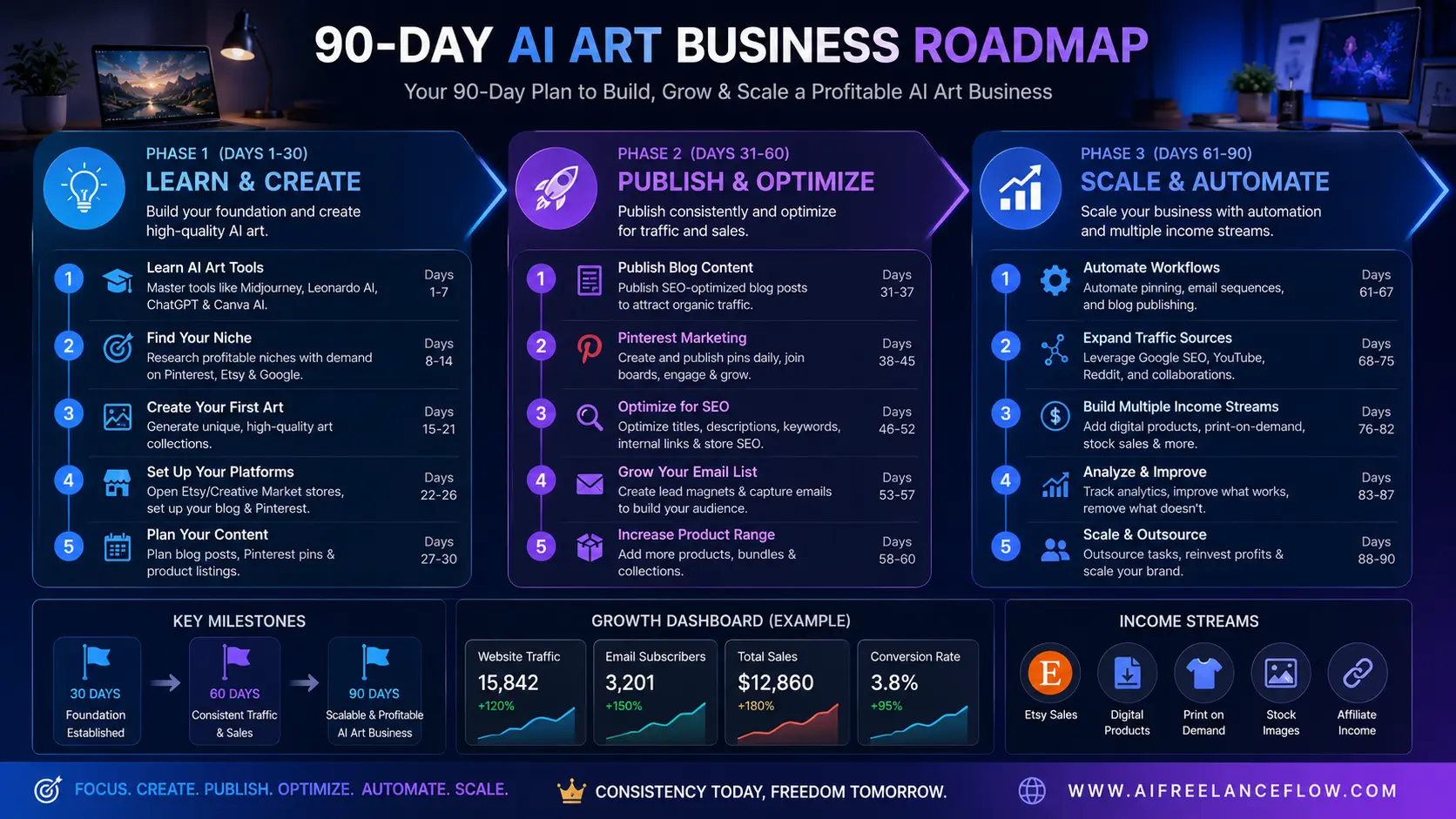
This roadmap is an illustrative example and not a guarantee of results.
| Time Period | Focus | Expected Outcome |
|---|---|---|
| Days 1–30 | Learn one AI tool, choose a niche, create a portfolio | Foundation and first products |
| Days 31–60 | Publish consistently, optimize listings, create Pinterest content | Initial traffic and customer feedback |
| Days 61–90 | Expand product range, improve SEO, build an email list, diversify platforms | More stable and scalable business system |
AI Art Launch Checklist
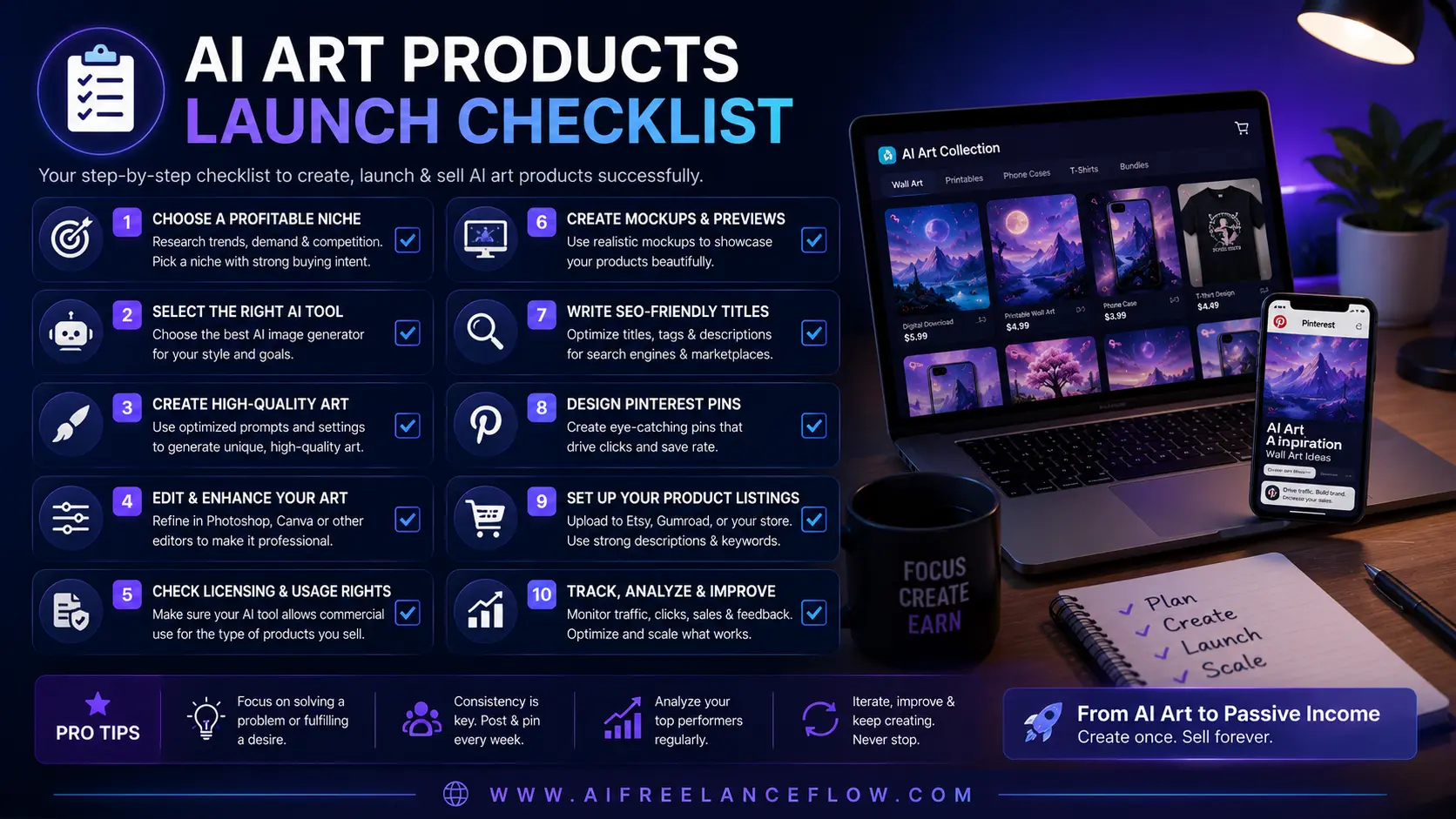
- Choose a clear niche.
- Learn one AI image generator.
- Edit every image before publishing.
- Check commercial licensing terms.
- Create professional mockups.
- Write SEO-friendly titles and descriptions.
- Add descriptive ALT text to images.
- Prepare multiple Pinterest Pins.
- Publish consistently.
- Track analytics and improve based on real data.
Suggested Visual Content for This Article
| Placement | Visual | ALT Text | Goal |
|---|---|---|---|
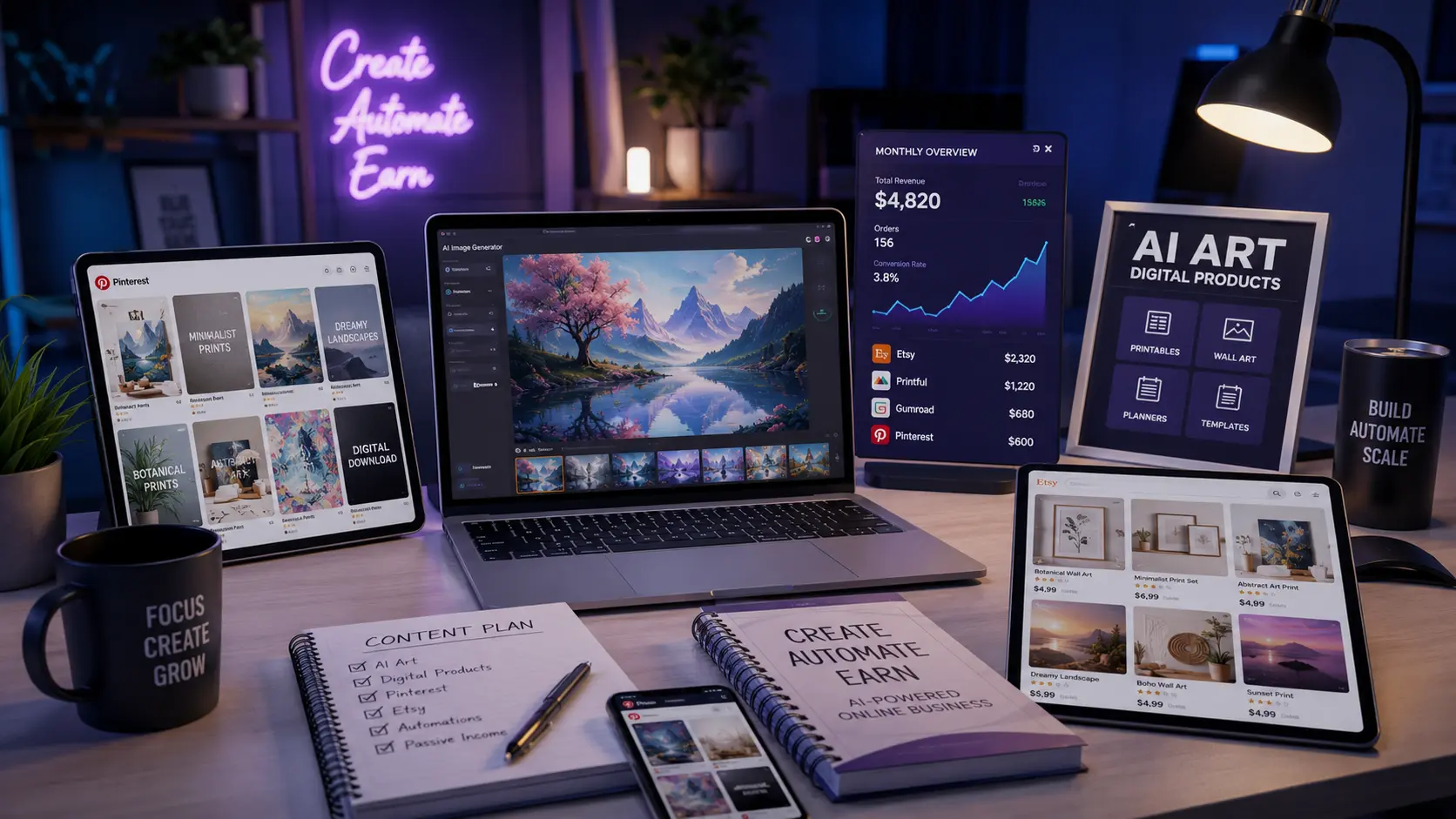
| After Introduction | Hero workspace image | How to make money with AI art using AI tools and online marketplaces | Introduce the topic |
| After Best AI Tools | Comparison infographic | Comparison of popular AI image generators for creators | Help readers choose tools |
| After Business Framework | Workflow diagram | AI art business workflow from idea to income | Explain the process |
| Before Pinterest section | Pinterest strategy infographic | Pinterest marketing workflow for AI art creators | Show traffic generation |
| Before Conclusion | Roadmap graphic | 90-day AI art business roadmap | Summarize implementation |
Frequently Asked Questions
Can you really make money with AI art?
Yes, but success depends on creating products people want, marketing them effectively, and choosing the right business model. AI speeds up content creation, but it does not guarantee sales.
Is AI art still worth selling in 2026?
Yes. Competition has increased, but so has demand for visual content. The opportunity has not disappeared; it has simply become more professional.
Which AI art tool is best?
There is no single best tool. Choose based on your goal. ChatGPT Images works well for beginners, Canva AI for marketing graphics, Midjourney for premium artwork, Adobe Firefly for commercial design workflows, Leonardo AI for detailed illustrations, and Ideogram for typography images.
How long does it take to earn money?
There is no fixed timeline. Results depend on product quality, market demand, pricing, marketing, SEO, Pinterest traffic, and consistency.
Do I need to be an artist?
No. Traditional drawing skills can help, but prompt writing, product design, branding, copywriting, marketing, SEO, and customer research often have a greater impact on business success.
Is selling AI art legal?
In many cases, yes. However, always review the commercial-use terms of your AI image generator, the marketplace policy, and any licensing restrictions that may apply.
Can AI art become passive income?
AI art can support passive income through digital downloads, print-on-demand, stock image libraries, prompt packs, and memberships. However, products still benefit from updates, better listings, and ongoing promotion.
Is Etsy the best platform?
Etsy is useful for many beginners, especially for printable products and digital downloads. However, you should also consider Gumroad, Creative Market, Creative Fabrica, Adobe Stock, and your own website.
How important is Pinterest?
Pinterest can become one of the strongest long-term traffic sources for AI art. Unlike fast-moving social platforms, Pins can continue driving visitors months after publication.
Should I start a website?
If your goal is building a long-term business, yes. Marketplaces are useful, but your own website gives you more control over branding, SEO, email subscribers, affiliate marketing, analytics, and product presentation.
What is the best beginner method?
The best beginner method is usually digital downloads, freelance graphics, or prompt packs because they require low startup costs and help you learn customer demand quickly.
Can I use AI art for affiliate marketing?
Yes. AI art can improve blog visuals, Pinterest Pins, comparison graphics, and social media assets that support affiliate content and increase engagement.
Final Verdict
Learning how to make money with AI art is not about finding a secret AI prompt or chasing the latest image generator. It is about building a system that creates value for real people.
The most successful creators typically combine AI-generated visuals with practical skills such as SEO, content marketing, product research, branding, and audience building. AI can significantly reduce production time, but it does not replace thoughtful planning or consistent execution.
If you are just getting started, resist the temptation to do everything at once. Choose one niche, master one AI image tool, publish a small collection of high-quality products, and pay close attention to customer feedback.
Over time, you can expand into print-on-demand, digital downloads, freelancing, blogging, affiliate marketing, or membership products.
There is no guaranteed formula for success, and no tool can replace persistence. But by focusing on solving real problems, improving your workflow, and creating assets that people genuinely find useful, you give yourself a much stronger chance of building a sustainable AI-powered business.
Next Steps
If your goal is to build a complete AI income ecosystem rather than simply sell artwork, start with one AI image generation platform, create your first niche product collection, publish on a marketplace and your own website, drive traffic with Pinterest and SEO, build an email list, and reinvest your knowledge into new products and improved workflows.
Each step builds on the previous one. Over time, those incremental improvements can evolve into a durable online business.
Conclusion
Understanding how to make money with AI art is ultimately about combining creativity with strategy. AI provides the tools, but your research, positioning, marketing, and consistency determine the outcome.
Whether you choose to sell digital downloads, create print-on-demand products, offer freelance services, or build a content-driven business, focus on delivering genuine value to your audience.
Markets change, AI tools evolve, and trends come and go, but businesses that solve real problems and continue learning are far more likely to succeed over the long term.
Start small, keep refining your process, and treat every project as an opportunity to improve. That is a far more reliable path than chasing shortcuts, and it is the mindset that turns AI art from a hobby into a sustainable business.
Build Your AI Income System Step by Step
Start with one niche, one product collection, and one traffic channel. Then expand into freelancing, Pinterest, SEO, affiliate marketing, and automation when your workflow becomes consistent.
Read More AI Money-Making Guides